Most gaming pitches arrive with a mood board, a platform already chosen, and a visit forecast nobody can trace back to a source. That is a thin basis for a six-figure decision, and it doesn't have to be. GEEIQ tracked 1,011 brand activations in virtual worlds in 2025, 88% of them on Roblox and Fortnite, and every one of them left data behind. There is evidence for every part of this decision, if you ask for it.
This article gives you seven questions to put to any agency or studio before money moves. Each comes with the reason it matters, a real example with numbers, and the specific evidence a good answer contains.
If you're on the agency side, read on anyway. This is the brief you want to receive.
1. Why gaming, and why for us?
Start here, because everything else depends on the answer. Agencies tend to open with how: the build, the platform, the creative. The useful conversation opens with why. What is the brand trying to change, for whom, and how will anyone know it happened?
Why it matters
An activation without a named objective can't be measured, priced or repeated. It also can't be defended when the CMO asks what the money did. The IAB's Business Case for Gaming guide, published in August 2026, is blunt about it: reject vague test-and-learn proposals and ask for a recommendation that names the business objective and shows how gaming supports it.
The receipt
The audience case is strong enough that nobody needs to inflate it. US Gen Z spend 2.6 hours a day on Roblox against 1.5 hours on TikTok (GEEIQ State of Brands in Gaming 2024; Insider Intelligence 2024). Players sit in a focused state 73% of the time they play, against 57% for video streaming and 40% for social media (McKinsey). If your audience is under 30, the attention is there. The open question is what you want from it.
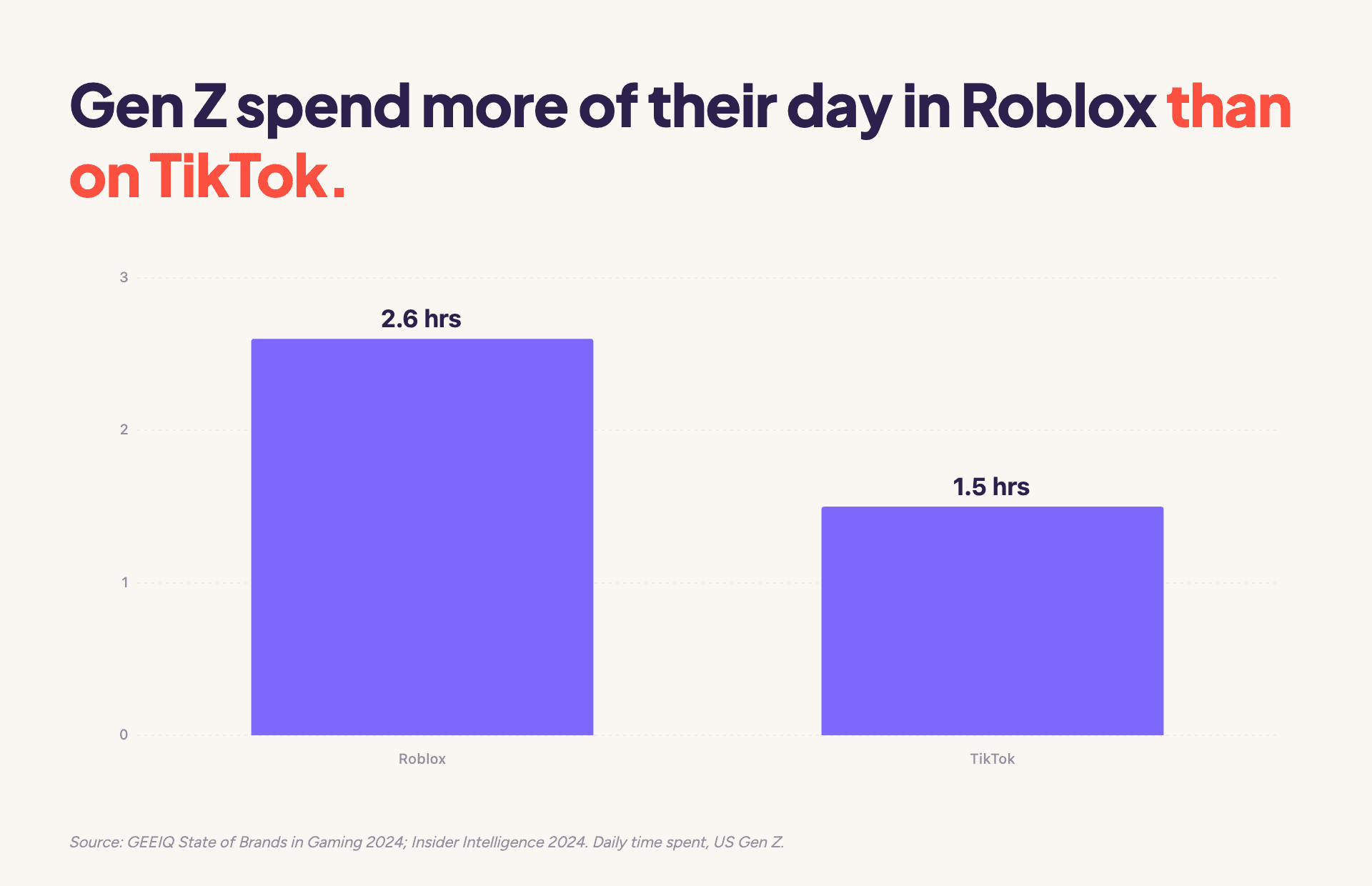
Daily time spent by US Gen Z: 2.6 hours on Roblox, 1.5 hours on TikTok. Source: GEEIQ State of Brands in Gaming 2024; Insider Intelligence 2024.
Ask to see
The objective, written as one of awareness, consideration, conversion or loyalty, with the KPI that goes with it.
Evidence that your audience is in gaming at all: age, gender, time spent, category behaviour. Your Gen Z, in particular.
A decision rule agreed before launch: which result means scale, which means iterate, which means stop.
A good answer names a funnel stage and a number. "Test and learn" without either is a warning sign. If you need the internal version of this argument, we've written up how to make the gaming case to your CMO.
2. What is already being built with our brand?
Most brands appear in virtual worlds before they arrive. Players build items, shops and roleplay worlds around the brands they like, and those worlds gather visits whether the brand counts them or not. An agency that pitches a build without checking this is starting from zero when you may already have millions of visits to answer.
Why it matters
The existing footprint changes the brief. It tells you which platform your audience already chose, which formats they made for themselves, and how much demand a first official move could inherit. It is affection you haven't answered yet, and it is measurable.
The receipt
KFC has around 70 million lifetime visits to fan-made Roblox experiences, 44 million of them to a single game called Escape KFC Obby, plus roughly 600 fan-made items on the marketplace, with no official presence on Roblox (GEEIQ snapshot, August 2026). Naruto experiences hold 260.6 million visits with nothing official behind them. Gucci has 138 unofficial items against 12 official ones. Walmart is the counter-example: an official Roblox world with 39.3 million lifetime visits sitting alongside 112.2 million fan-made, each feeding the other. We told the full story in the 70 million visits KFC never asked for.
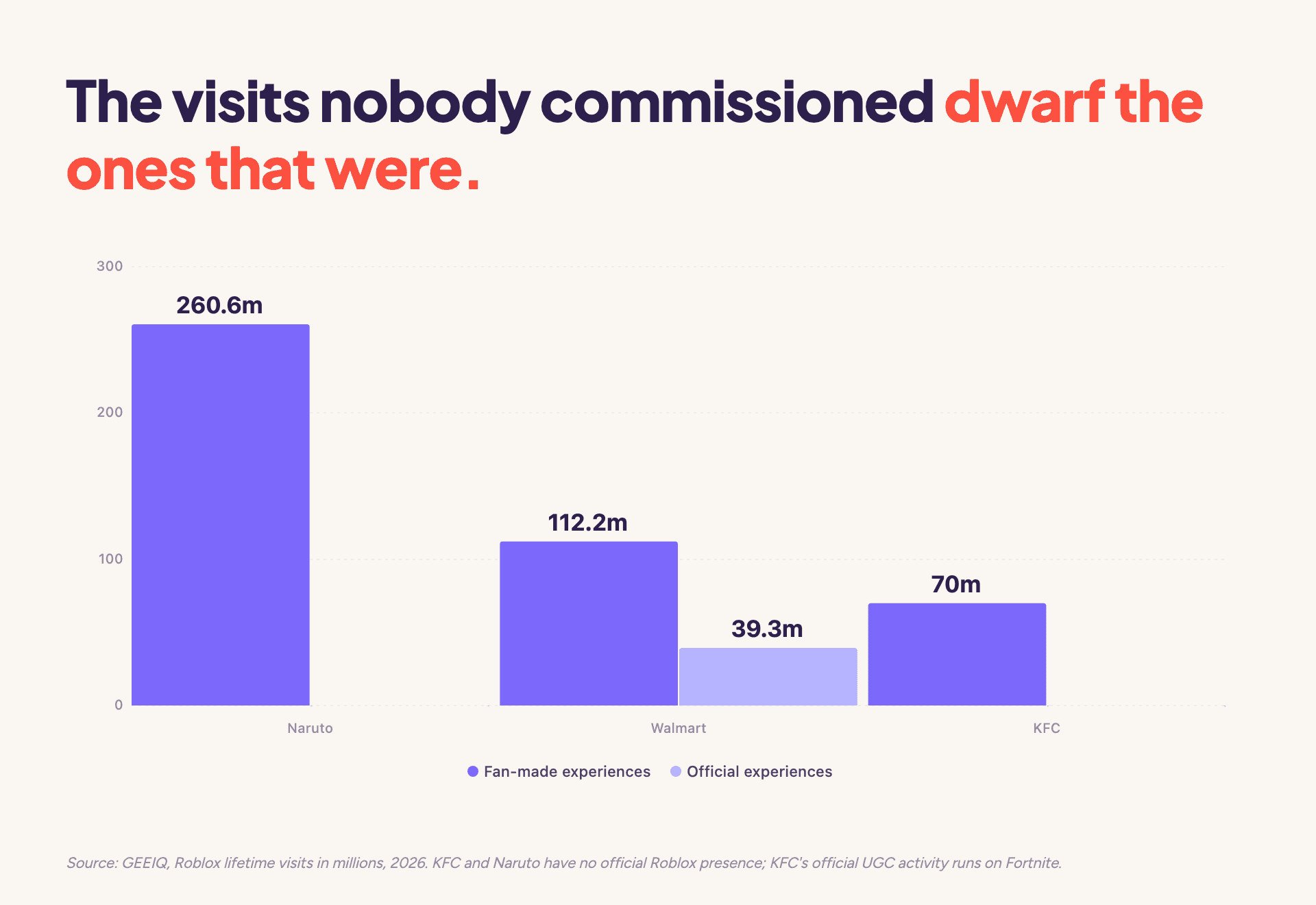
Lifetime Roblox visits, millions. Walmart is the only one of the three that answered the demand it found. Source: GEEIQ, Roblox lifetime visits 2026.
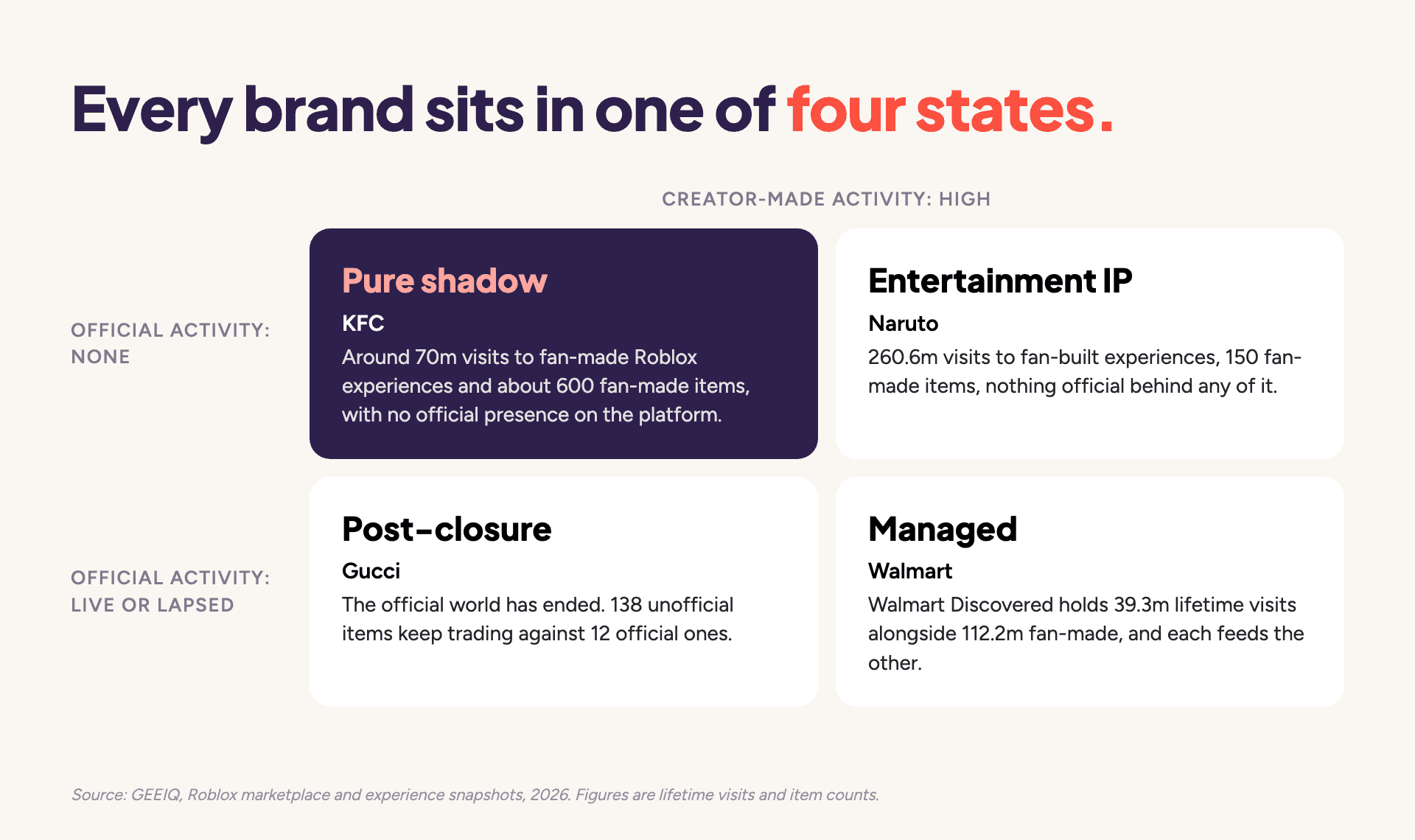
Pure shadow, entertainment IP, post-closure, managed. Knowing which one you're in decides the brief. Source: GEEIQ brand snapshots, 2026.
Ask to see
A count of the experiences and items already carrying your brand name, with lifetime visits and the creators behind them.
How your category shows up: which competitors have activated, on which platforms, how often.
What the agency plans to do with that demand, rather than around it.
A good answer starts with a number you didn't know. You can get a rough one yourself: search the Roblox marketplace and experience search for your brand name and its short forms, then strip out the noise. If you'd rather have it done properly, enter your brand at geeiq.com/brand-check and a GEEIQ analyst sends you a snapshot of your brand's visibility across gaming, official and creator-made, within two working days. It puts eight years of tracked category activity next to your own footprint, which is the part a marketplace search can't do.
3. Which platform, and how do you know?
Scale and fit are different things. The biggest platform is the right one only if it holds your audience, and the honest answer to "which platform" is sometimes "not the one the agency knows best".
Why it matters
In 2025, 88% of brand activity sat on Roblox and Fortnite (GEEIQ State of Brands in Virtual Worlds 2026), so the choice usually comes down to two platforms with very different audiences, with ZEPETO as a third option for a female-led fashion and music crowd. Bets beyond those three now carry platform risk: Rec Room, once valued at $3.5 billion, closed in June this year. Picking on popularity, or on somebody's personal gaming taste, is how brands end up in front of the wrong people at scale.
The receipt
Roblox has 380 million monthly players, Minecraft 200 million, Fortnite 130 million and ZEPETO 33 million (GEEIQ estimates, Brands in Gaming 101, 2026). Roblox splits evenly by gender with a majority under 17: among age-verified users, 35% are under 13, 38% are 13 to 17 and 27% are 18 and over (Roblox, Q1 2026). Fortnite is male-led and older. Walmart Discovered reached 20 million visits in six months with 65% of players aged 18 and over, which is exactly the customer Walmart set out to reach. Same platform, deliberately chosen audience.
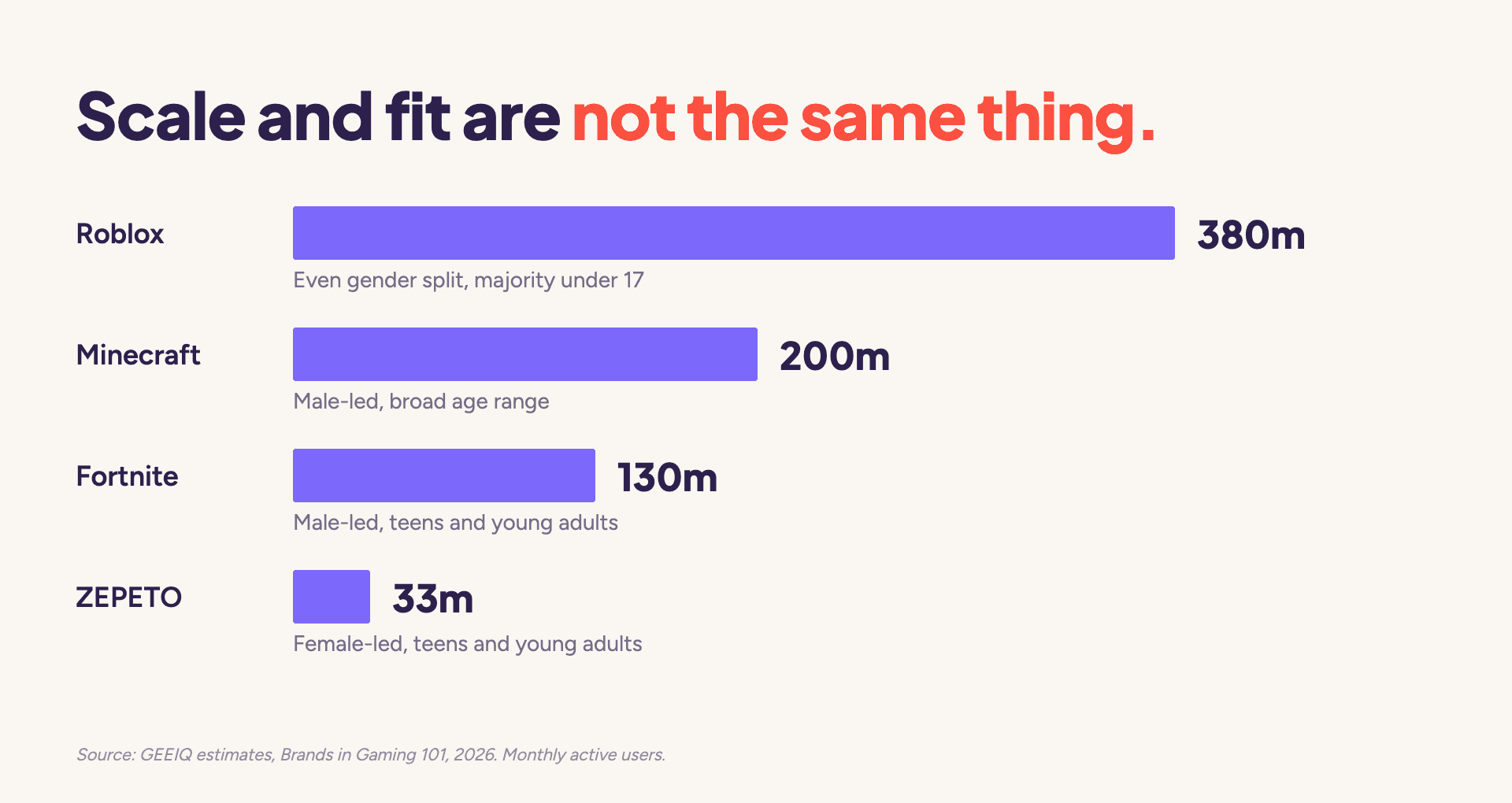
Monthly players by platform, with the audience each one skews to. Source: GEEIQ estimates, Brands in Gaming 101, 2026.
Ask to see
Audience overlap for your target on each candidate platform: age, gender, region.
What each platform lets you target and measure, including whether a market pilot can be geo-targeted.
The formats each platform actually sells: owned world, integration, UGC items, in-world ads.
A good answer compares two platforms on your audience, and one of them loses. For the longer version, start with which gaming platform is right for my brand.
4. Are you proposing we build a world or join one, and why?
This is the most expensive decision in the pitch. A brand-owned world is a live service with a running cost, and its results are decided in years two and three. An integration borrows an audience that already exists and goes live in weeks. Both are legitimate. The question is whether your agency can defend its choice against your objective and your budget.
Why it matters
In 2025, brand integrations outnumbered brand-owned worlds for the first time, 337 to 252, and the number of new owned worlds fell 57% year on year while integrations grew 16% (GEEIQ State of Brands in Virtual Worlds 2026). On Fortnite, brand-owned islands fell from 231 to 75 in a single year while integrations rose from 45 to 65 (Naavik, State of UGC Games 2026, using GEEIQ data). Experienced brands are moving too: 31% of the brands that integrated in 2025 had previously built an owned world.
The receipt
Owned worlds decay without a content pipeline. Of the top 229 branded Roblox games by lifetime visits, about half were still being played at 12 months, a third at 24 months and 4% at 36 (Daniel O'Sullivan, analysis of Romonitor Stats data, June 2026). The survivors shared three traits: 250 or more concurrent players sustained after the first year, average sessions above eight minutes, and a steady flow of updates. Two of the three are operating costs rather than launch costs. And the sample is games that once ranked, so the true survival rate across all branded worlds is lower still.
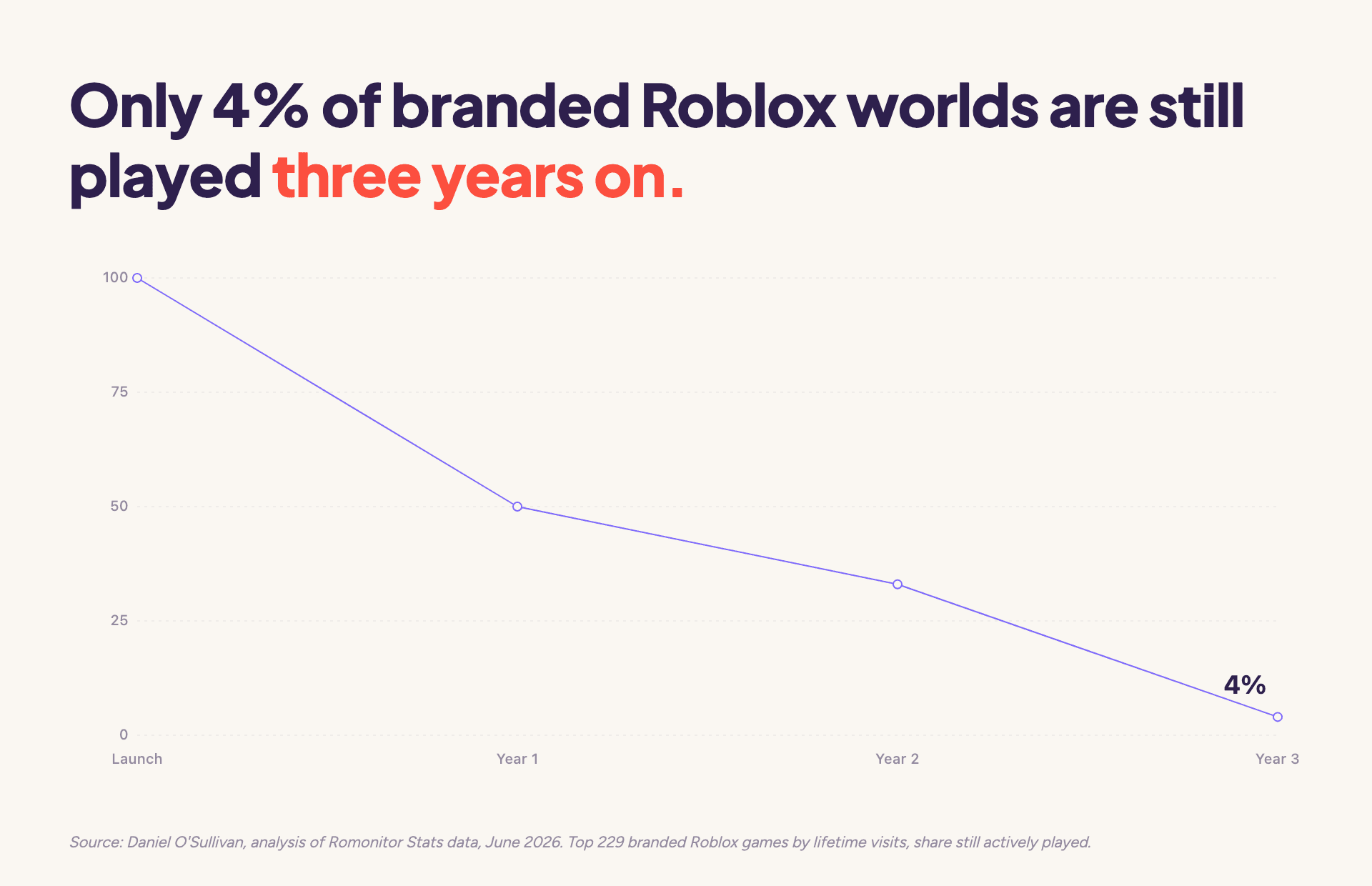
Share of the top 229 branded Roblox games still actively played, by years since launch. The sample is games that once ranked by lifetime visits, so the rate across all branded worlds is lower. Source: Daniel O'Sullivan, analysis of Romonitor Stats data, June 2026.
Ask to see
The format argued against the objective and the budget, with the alternative costed alongside it.
For an owned world: the content calendar and live-ops cost for 24 months, and the concurrency and session-length targets that keep it alive.
For an integration: the host experience's audience data, retention and approval rating, and who else has integrated there. In 2025, 173 experiences hosted integrations, and 74% of them did so for the first time.
A good answer treats an owned world as a three-year commitment, or explains why an integration wouldn't do the job. Four reasons brand integrations lead virtual worlds covers the economics in more depth.
5. How will people find it, and what happens when you buy traffic?
Discovery is the binding constraint on every platform. Roblox users engaged with around 24 different experiences a month in 2025, and more than 1,500 experiences carry over a million monthly users each (Naavik, 2026). A new world competes with all of them for attention it hasn't earned yet, so launch traffic is usually bought: Roblox ads, creator seeding, cross-promotion from other experiences.
Why it matters
Bought visits behave differently from organic ones, and a visit total that mixes the two tells you nothing about whether the idea worked.
The receipt
Across seven Roblox experiences in GEEIQ's data pool, session time fell by around 30% during paid media periods, while new users rose by around 20% and returning users by 5% (GEEIQ analysis, September 2024). More people came, and they stayed for less time. Paid media still earns its place. Report it on its own line. Roblox itself has moved into selling ads and has changed how it evaluates experiences, both of which raise the stakes on the traffic plan.
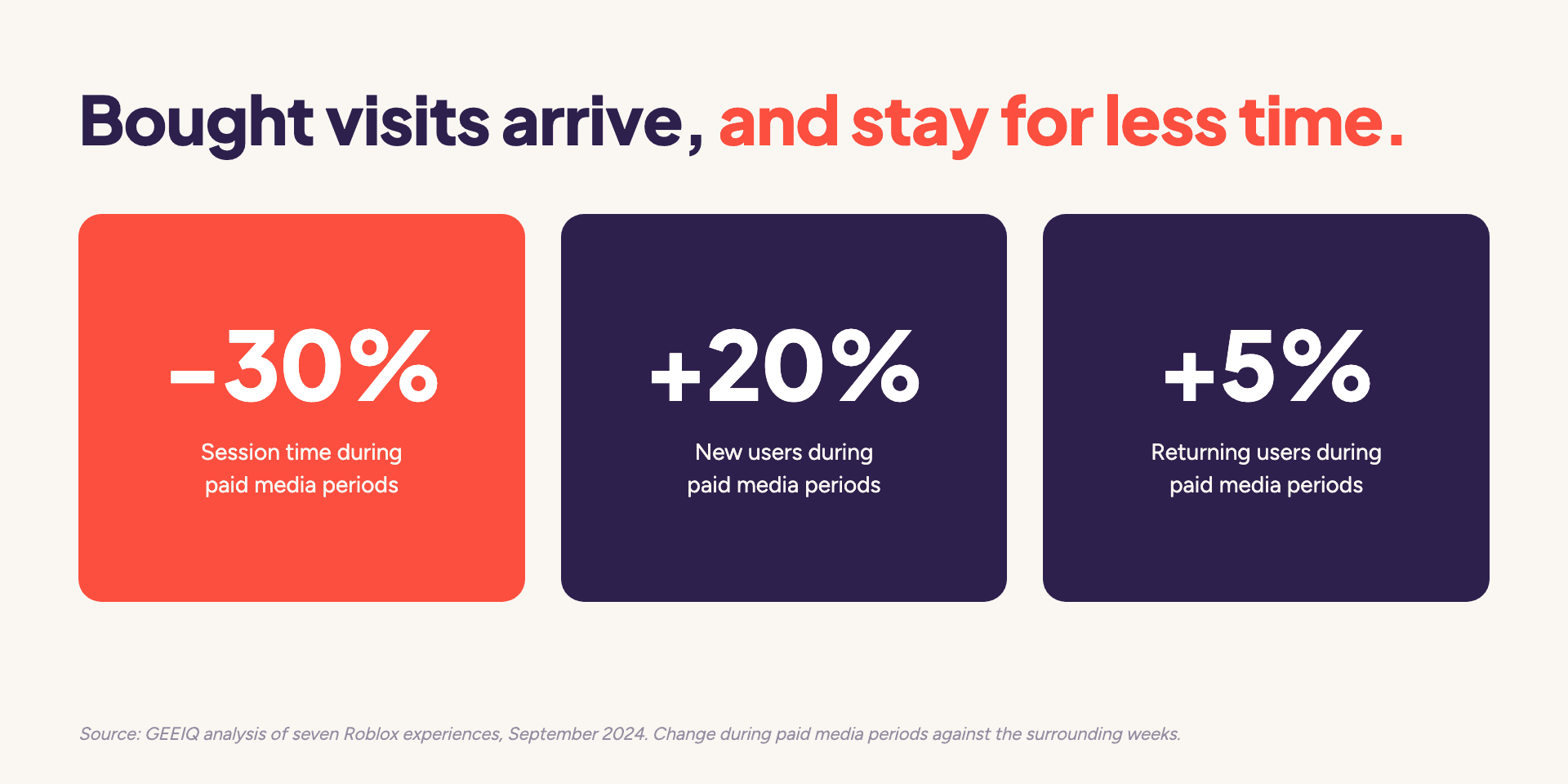
Change during paid media periods: session time down around 30%, new users up around 20%, returning users up 5%. Source: GEEIQ analysis of seven Roblox experiences, September 2024.
Ask to see
The traffic plan split into organic, creator-led and paid, with the assumed cost per visit for each.
How reporting will separate paid visits from organic ones, with session time for each.
Which creators are in the plan and what their audience data says, beyond follower counts.
A good answer has two visit lines in the report rather than one. For the creator side, see how to find and work with Roblox influencers.
6. What does it cost, who builds it, and who takes a cut?
Brands regularly pay more for an activation than they needed to, because nothing told them what good value looks like. Nobody is being accused of anything here. Every channel goes through this before its buyers have benchmarks.
Why it matters
Most of the people who build brand worlds reach the brand through someone else: 86% of developers and creators report working on brand activations through at least one intermediary (GEEIQ State of Brands in Virtual Worlds 2026, survey of more than 50 studios and creators). Each layer takes margin, and budgets move mid-project: 53% of developers reported reduced brand budgets on projects that went ahead, and 61% saw changes in the brand's commissioning team. None of this is a scandal. Procurement discipline is arriving late to a channel that ran without it.
The receipt
For scale, GEEIQ's Brands in Gaming 101 guide works through a market pilot integration in an existing experience at around $70,000, with no bespoke build. An owned world with a live-ops plan sits in a different bracket entirely. The developers we interviewed at the Roblox Developer Conference put the fix plainly: talk to the people who make the games, because they know the audience better than anyone.
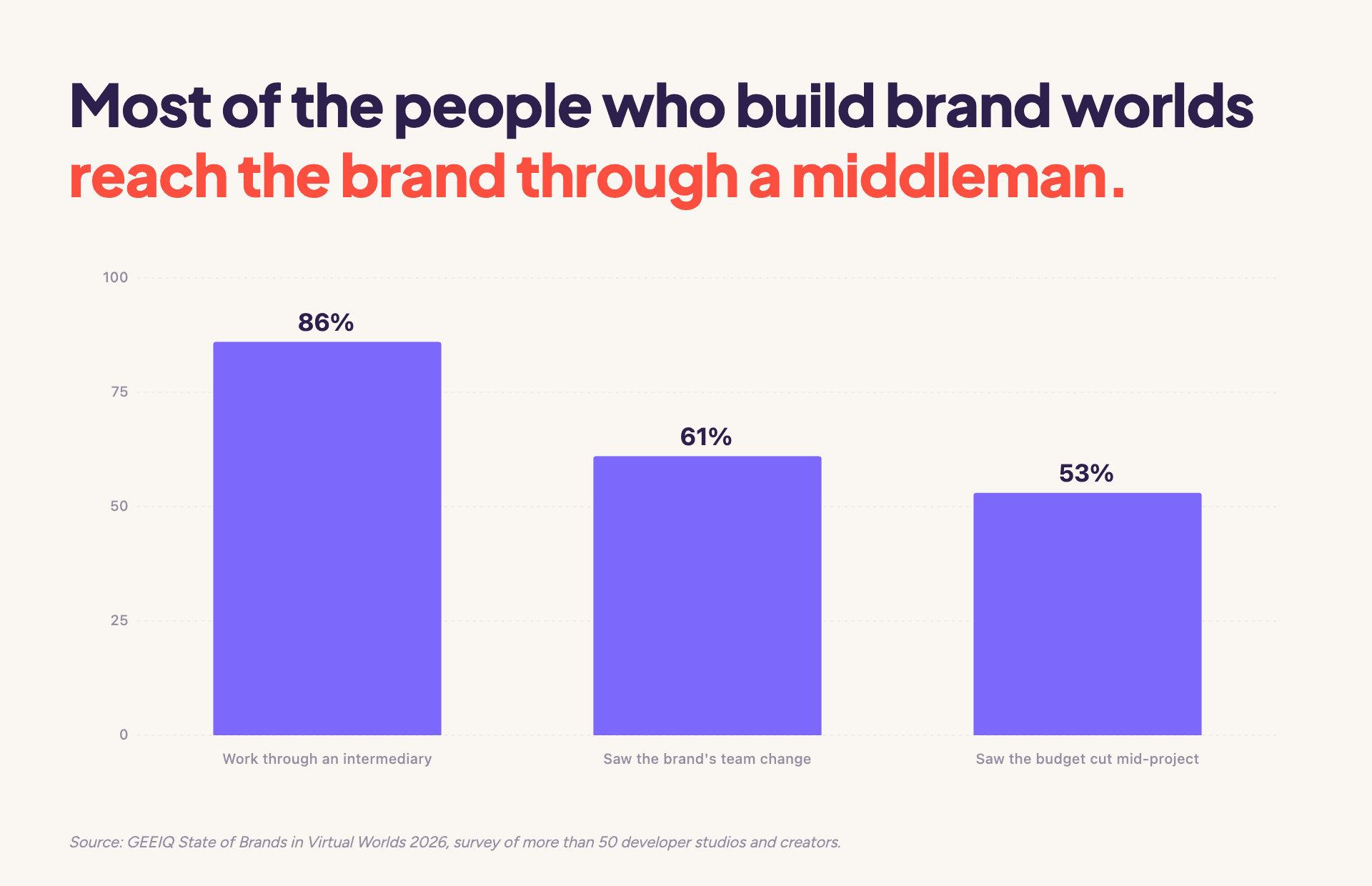
86% of developers and creators work through at least one intermediary, 61% saw the brand's commissioning team change, 53% saw budgets cut on live projects. Source: GEEIQ State of Brands in Virtual Worlds 2026, developer survey.
Ask to see
A line-item budget separating strategy, build, media, creator fees and the studio's share.
The developer's name, their track record on the platform, and whether you can talk to them directly.
What comparable activations in your category cost and returned. If your agency can't show this, ask who can.
A good answer shows you where the money goes and introduces you to the studio. What virtual world developers really want from brands explains why that introduction matters to them too.
7. How will we know it worked, and against what?
"The impression is the least interesting thing about gaming," Stephanie Whitley of Dubit told The Drum in June 2026, in a piece gathering the industry's case for measuring gaming on engagement rather than served views. She's right, and it cuts both ways: visits alone mislead, and a number without a benchmark is a number nobody can act on.
Why it matters
Value from a gaming activation lands on two ledgers. On the platform: visits, session time, favourites, item sales, repeat visits. Off the platform: brand search, brand lift, sales uplift, CRM sign-ups. Agree which signals matter before launch, and match them to the stage of the funnel you're trying to move. The IAB puts the governance rule well: outcome signals earn the right to optimise, and business impact earns the right to scale.
Funnel stage | On-platform signal | Off-platform signal |
|---|---|---|
Awareness | Visits, unique visitors, impressions | Earned press and social, share of voice |
Consideration | Average session time, brand search on the platform, favourites | Brand uplift, web brand search, social following |
Conversion | Digital item sales, digital revenue | Physical sales, sales uplift |
Loyalty | Repeat item purchases, returning visits | CRM registrations, cost per acquisition |
The KPI ladder by funnel stage. Source: GEEIQ, Brands in Gaming 101.
The receipt
Benchmarks exist if you ask for them. GameAnalytics' 2025 Roblox benchmarks show median day-one retention rising from 4.3% for games with sessions under three minutes to 11.5% for 19 to 24 minute games, and day-30 retention below 1% in every tier. A branded world that loses most of its players within a month is behaving normally for the platform, and that context changes how you read the report. Approval ratings are a public benchmark almost nobody quotes: Walmart Discovered posted 96.34%, e.l.f. Beauty's Roblox world 96% across 345,000 votes. And when the objective is media efficiency, the numbers tie back to spend: DAISE's Easter scavenger hunt on Roblox delivered 145 million impressions at a $0.68 blended CPM, an 8.2 point awareness lift among 16 and overs, and 59% positive purchase intent (GEEIQ case study).
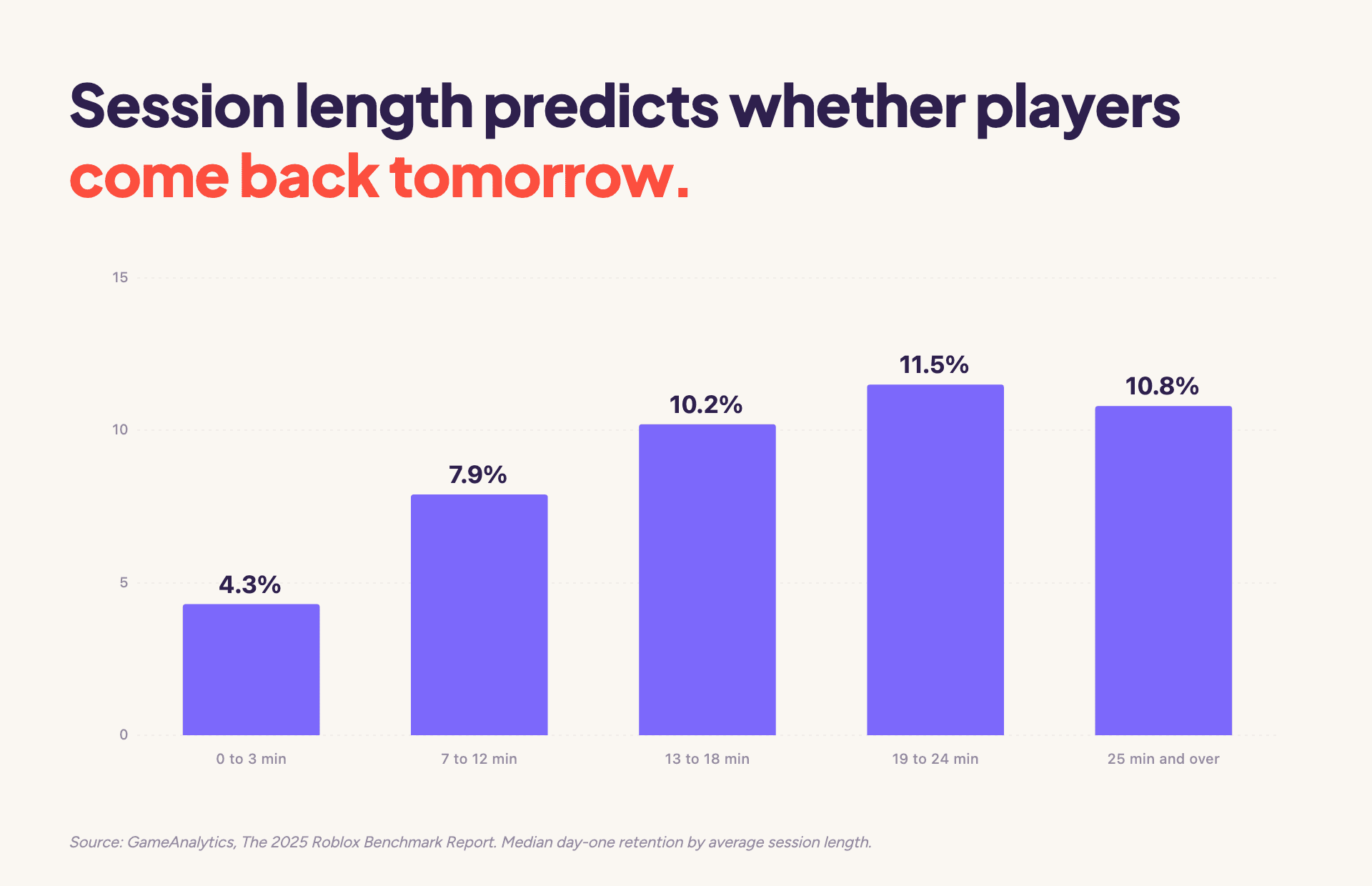
Median day-one retention by average session length: 4.3% (0 to 3 minutes), 7.9% (7 to 12), 10.2% (13 to 18), 11.5% (19 to 24), 10.8% (25 and over). Source: GameAnalytics, The 2025 Roblox Benchmark Report.
Ask to see
KPIs named per funnel stage before launch, with one on-platform and one off-platform measure for each.
The benchmark you'll be judged against: category peers, platform percentile, or your own social equivalent.
The reporting cadence, and the scale-or-stop threshold you agreed in question 1.
A good answer includes at least one business signal from outside the platform. For the mechanics, see what EMV is and why it matters and the 10 gaming metrics you need to know.
Ask before you sign
A good partner will have most of these answers already, because they're the same questions any brand asks of social or search. Gaming has escaped them for a while. It doesn't need to.
You don't need all seven before the first conversation. Three will change the shape of the pitch: why, what already exists, and how you'll measure it.
Question 2 is the one you can answer today without anyone's help. Enter your brand at geeiq.com/brand-check and see what players have already built with it.
Check your brand’s gaming footprint
A GEEIQ analyst sends you a free snapshot of your official and unofficial presence across gaming