The UK's under-16 social media ban now has a date: March 2027. Australia's has been in force since December 2025. Indonesia, Malaysia, France, Denmark, Greece, Turkey and the UAE are in various stages of the same move, and on 16 September the European Commission proposed one for the whole bloc.
For anyone who buys media against a young audience, this is the biggest change to the channel since the feed went algorithmic. This piece sets out what's happening, what a ban actually does to a campaign, and what the numbers say about gaming and virtual worlds as the place that audience can still be reached.
The ban map, country by country
What a ban does to a media plan
Where under-16s are still allowed to be
Is Roblox social media?
Gaming versus social, the comparative stats
What brands are doing about it
The ban map
Twenty-plus countries now have a minimum age for social media in force, passed, or on the table. The thresholds vary between 13 and 16. The direction doesn't.
In force
Australia. Under 16, since 10 December 2025. Covers Facebook, Instagram, Snapchat, TikTok, YouTube, X, Threads, Reddit, Twitch and Kick. Platforms had removed 4.7 million accounts by mid-December.
Indonesia. Under 16, since 28 March 2026. Eight "high-risk" platforms, and Roblox is one of them. More on that below.
Malaysia. Under 16, enforcement from June 2026 under the Online Safety Act. Games are explicitly excluded from the first phase.
Passed or dated
UK. Under 16. Announced 15 June 2026, date confirmed as March 2027 by Culture Secretary Lisa Nandy on 27 September. TikTok, Snapchat, YouTube and Instagram are named. Blocks on livestreaming and adult-to-child messaging come with it.
France. Under 15. Passed by parliament, effective from the September 2026 school year.
Denmark. Under 15, with a parental override at 13 and 14. Agreed in November 2025 for mid-2026.
Greece. Under 15, from 1 January 2027, enforced through the state's Kids Wallet app.
Turkey. Under 15. Passed on 23 April 2026, six months to enforcement. Gaming platforms must classify their games by age.
UAE. Under 15, with a compliance grace period to January 2027.
Proposed
European Union. The Kids Act, published 16 September 2026. No accounts under 13. Supervised "mini accounts" with limited features for 13 to 15. Infinite scroll and engagement-maximising design banned for minors. Online games are inside its scope.
New Zealand. Under 16. Bill introduced 24 August 2026; two coalition partners oppose it.
Norway, Spain, Canada, Austria, Slovenia, Vietnam. All drafting, at ages between 14 and 16.
United States. No federal ban. California passed under-16 curbs on infinite scroll and autoplay in September. Utah and Texas laws are enjoined in court. Florida's is partly enforceable.
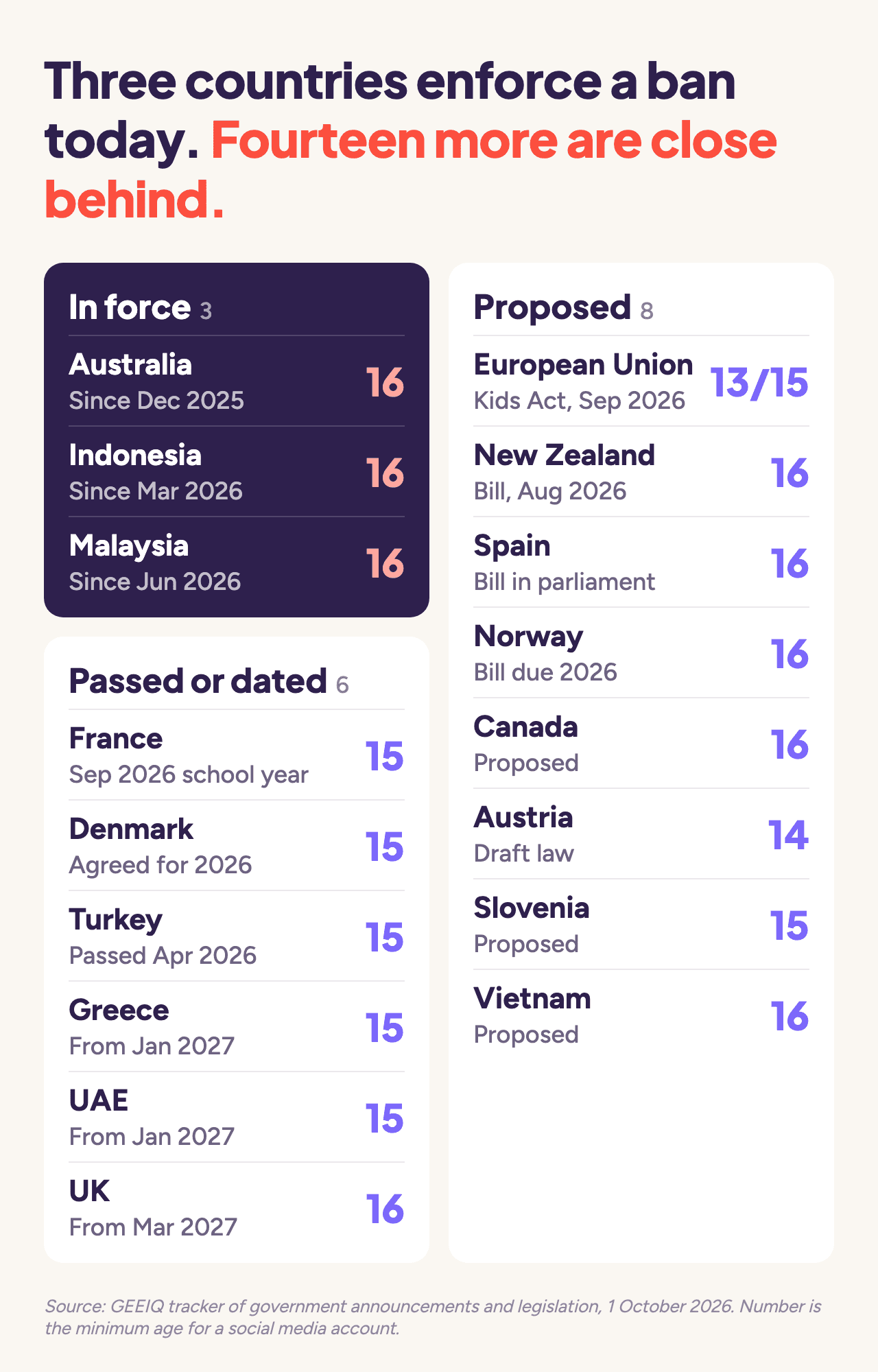
Minimum age for a social media account, by country and status, as of 1 October 2026. Source: GEEIQ tracker of government announcements and legislation.
What a ban does to a media plan
The honest answer is that a ban does less to teenagers than it does to your targeting.
Start with the headline numbers from Australia, the only market with a year of data. Platforms had removed more than five million under-16 accounts by June 2026. Meta alone reports 750,000 across Facebook and Instagram.
Then look at what the teenagers did. A University of Newcastle study in The BMJ found that over 85% of Australian under-16s were still using social media three months after the ban. In a separate survey, 61% reported "no or little change" in their use. They borrowed a parent's account, used a VPN, or browsed without logging in.
So the audience is still there. What's gone is your ability to reach it on purpose.
An account that legally cannot exist cannot be targeted. It can't be frequency-capped, added to a lookalike, or reported on. Every under-16 still on Instagram in Sydney is now declared as an adult, which means your youth campaign is either reaching them by accident or paying to reach their parents. Jessica Dervyn at Gartner put it plainly to Marketing Week: brands are "losing their direct line to a highly engaged segment".
The response in Australia has been a scramble. UNSW BusinessThink records fashion retailers moving to billboards and bus wraps, and McDonald's leaning on in-store Happy Meal tie-ins. Media agencies quoted by The Current list the reallocation candidates: broadcaster video, cinema, out of home, audio, and "gaming communities" as "contextually relevant replacement channels".
Note: this only bites for the under-16 slice of your audience. Nobody is banning 16 to 24s from anything. The case for gaming with that group rests on attention, not access, and it's covered further down.
Where under-16s are still allowed to be
Most of the bans draw the line at social media and stop. Gaming sits on the other side of it.
Australia's regulator, eSafety, publishes the list of services that don't meet its definition of an age-restricted platform. Roblox, Discord, Steam, WhatsApp and YouTube Kids are on it. The reasoning was practical as much as principled: requiring age checks to play Minecraft would lock hundreds of thousands of children out of something the government considered creative rather than corrosive.
Malaysia's Deputy Communications Minister said the same thing more bluntly. Games were left out because "we don't want to be overly ambitious". The UK's ban names TikTok, Snapchat, YouTube and Instagram and says nothing about Roblox or Fortnite.
That matters because of how much of the audience is already in those places. Ofcom's 2026 children's media report found that around four in ten UK 11 to 17s use Roblox, level with Instagram. Gaming is the single most popular free-time activity for 8 to 17s, picked by 43% against 36% for TV and film.
Further reading: Which gaming platform is right for my brand?
Is Roblox social media?
Regulators disagree, and the disagreement tells you something.
Australia, Malaysia and the UK say no. Indonesia said yes, and put Roblox on the same list as TikTok and Instagram. Roblox restricted chat for under-16s there and moved them onto separate account types, and on 30 April Indonesia's digital ministry confirmed it had fully complied. The same idea went worldwide on 16 June as Roblox Kids (ages 5 to 8) and Roblox Select (9 to 15).
Then on 31 August the European Commission designated Roblox a Very Large Online Platform under the Digital Services Act, alongside Reddit and ChatGPT. Forty-eight million monthly users in the EU. It's the first game to get the label, and the label comes with the same transparency and safety obligations as Meta's.
Add Moments, the short-form video feed Roblox rolled out across the US this year, and the platform looks more like social every quarter.
So the fair answer is this: Roblox is increasingly regulated like social media, and exempted from the bans, for the same reason. It can prove who it's reaching.
Since January 2026 Roblox has required a facial age check to use chat. By the end of Q2, 57% of daily users worldwide had completed one, and 70% in the US. The company's stated target is 90%. Of those age-checked users, 35% are under 13, 38% are 13 to 17, and 27% are adults.
No social platform can give you an audience like that. It's the difference between a channel that lost its under-16s on paper and one that can tell you, to the age bracket, who saw your brand.
Sidenote: exemption isn't immunity. Australia's eSafety Commissioner put Roblox under a court-enforceable undertaking in August after grooming reports, and has said gaming platforms could be added to the ban list "if warranted". The EU Kids Act includes games. Anyone planning a youth activation should assume the scrutiny follows the audience.
Gaming versus social, the comparative stats
The under-16 problem is about access. For everyone under 30, the argument for gaming and virtual worlds is about attention, and the numbers have been pointing the same way for a while.
Time. Gen Z and Gen Alpha players spend an average of 2.7 hours a day on Roblox, against 2.0 on TikTok, 1.3 on Instagram and 1.2 on YouTube, according to Gamefam's State of Brands in UGC Gaming report (December 2025). Roblox reported 123 million daily users and 29 billion hours in Q2 2026.
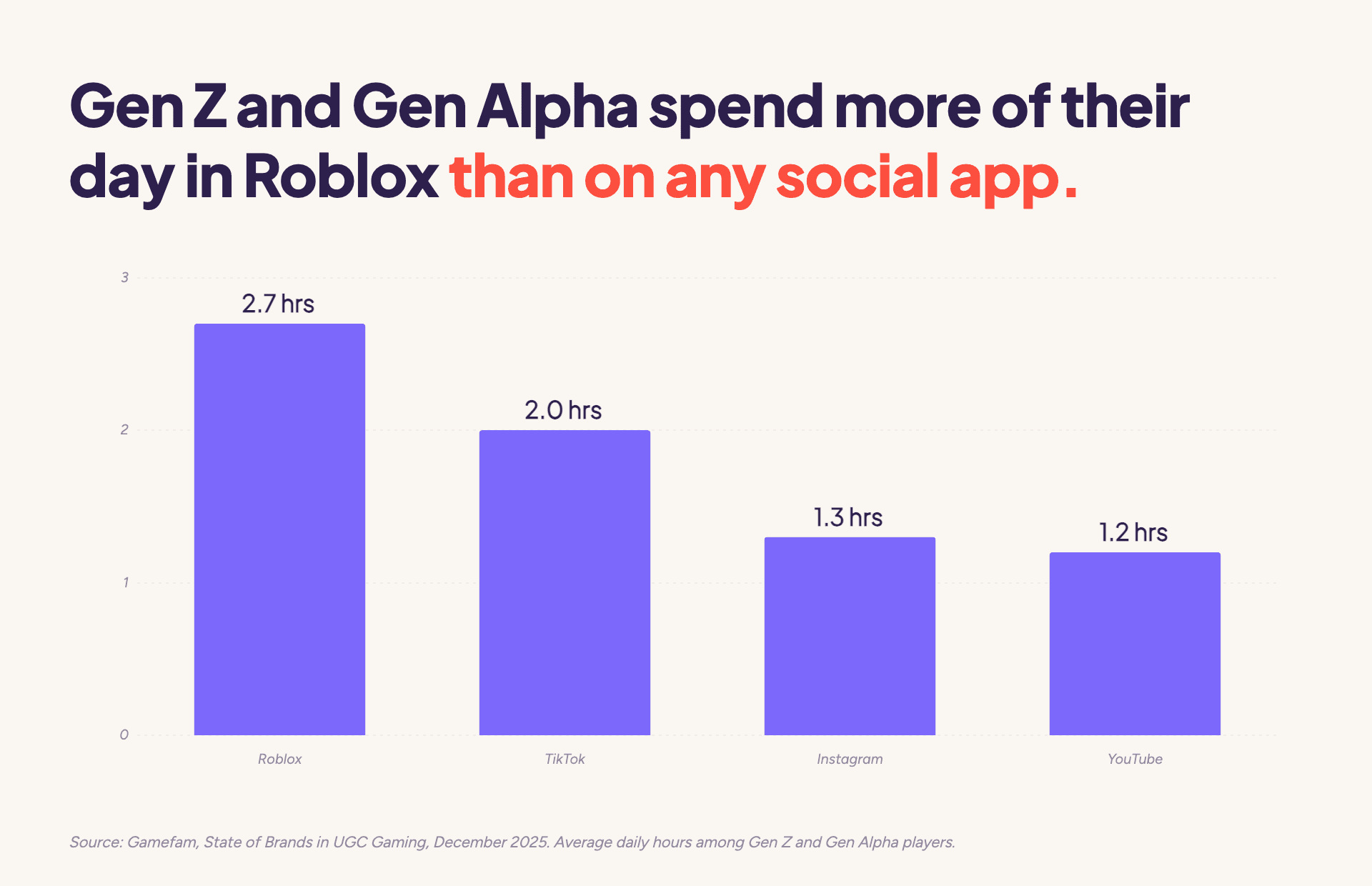
Average daily hours among Gen Z and Gen Alpha players: Roblox 2.7, TikTok 2.0, Instagram 1.3, YouTube 1.2. Source: Gamefam, State of Brands in UGC Gaming, December 2025.
Focus. McKinsey's attention equation study found console and PC gaming is the only digital medium that comes close to live events for focus: 73% of gaming time is spent in high focus, against 57% for streaming video, the next highest. Social video sits lower still. About 80% of it is watched alone, and people often browse, message or do chores while it plays.
Exposure. Yahoo and OMD Worldwide measured how long Gen Z gives an ad before scrolling: 1.3 seconds. GEEIQ platform data puts the average engagement with a brand experience in a game at 11 minutes. That is the gap between being noticed and being scrolled past.
Cost. Social isn't getting cheaper while it gets harder. Triple Whale's data shows Meta CPMs rising in every ecommerce vertical in 2025, by between 8% and 38%. Ryze's 2026 benchmark puts the all-industry average up 20% year on year, from $11.82 to $14.19. DAISE, a ZURU Edge fragrance brand, ran a multi-experience Roblox integration this year at a blended CPM of $0.68, 145 million impressions and an 8.2-point lift in awareness among over-16s.
Buyer sentiment. An IAB study of brands and agencies found 40% planning to increase games advertising spend in the coming year, and 85% confident they can measure it.
Further reading: Brands in Gaming 101: Virtual Worlds covers the five ways into gaming and how to pick a platform on the evidence.
What brands are doing about it
They're already moving. GEEIQ tracked 1,011 new brand activations across virtual worlds in 2025, and brands that activate now do so 1.8 times a year on average, the highest on record. Through the first eight months of 2026, Roblox and Fortnite between them have hosted between 40 and 78 new brand activations every month, 455 in total to the end of August. Eighty-eight per cent of all brand activity in virtual worlds sits on those two platforms.
The shape of the response has changed too. Integrations into existing hit experiences outnumbered brand-owned worlds in 2025, 337 to 252, because they're faster, cheaper, and put the brand where the audience already is rather than asking it to travel. DAISE is the template: integrations into experiences its audience already played, a $0.68 blended CPM, and an awareness lift it could measure by age bracket, which is exactly what social is losing for under-16s.
That last point is the one to hold onto. The bans don't decide where teenagers spend their time. They decide where brands can prove they reached them.
Final thoughts
Social media isn't going anywhere for adults, and the leakage numbers from Australia say it isn't going anywhere for teenagers either. What changes is what you can see and buy. Under-16s are becoming an audience you can't declare, target or measure on the platforms they still use, in more countries each quarter.
You don't have to rebuild your youth strategy this month. Start by finding out what your brand already looks like inside gaming: which experiences carry your name, who built them, and how many people are already there. Then decide whether to own it.
Check your brand’s gaming footprint
A GEEIQ analyst sends you a free snapshot of your official and unofficial presence across gaming