Brands have spent several years testing Roblox, Fortnite and Decentraland. The question now is what separates the activations that work from the ones that fade.
Speaking at an event hosted by international law firm Bird & Bird and GEEIQ, Will Deller (Partner, Bird & Bird), Charles Hambro (CEO & Co-Founder, GEEIQ), Amanpreet Singh (Global Media Innovation & Brand Partnerships Lead, Unilever) and Morgan Tucker (Head of Product, UGC, Rec Room) sat down to assess the landscape for brands activating across the virtual gaming ecosystem.
This panel took place in 2023. We have added findings from GEEIQ's State of Brands in Virtual Worlds 2026 report to show how the panel's advice has held up.
How do you define a polarising word like 'metaverse'?
The 'metaverse' is a loaded term. To many, it failed to live up to its post-pandemic hype, but Hambro argues that while the metaverse 'hype' is over, what it represents is very much here to stay.
'Games are the closest thing we can liken to the metaverse. These are no longer spaces that people are going into to just play, they're using them to socialise.' And brands are recognising this reality too.
'Brands are now approaching platforms like Roblox, Fortnite or Decentraland as new, 3D communications verticals - a natural evolution of social media, which is itself a natural evolution of print, TV and radio.'
So, how do brand activations work in this space?
Brand activations in virtual environments are a way to shift the needle from 'brand storytelling, to brand living' claims Singh. 'It's a new channel in which to engage users in an immersive fashion'.
With a number of mass brands that sell in hundreds of countries, Unilever is always looking at opportunities of scale, having previously activated in Roblox, Minecraft, Decentraland and Animal Crossing.
Traditionally, brands have focused on 2D advertising and one-dimensional narratives that tell the consumer why they should purchase their product, 'but in virtual environments, the consumer can own a part of the story and help shape it.'
What do brands get from this and how has it changed?
'We've moved from a broadcast model that pushed a brand to a consumer in a one-directional way, to lowering the barrier to connection on social channels with a form of bi-directionality, to now seeing consumers become an active part of the brand narrative in virtual environments', argues Tucker.
'In virtual environments, there's a sense of ownership that comes when players interact with brands. It's not just about consuming a story, it's about playing an active part in it - or potentially even creating your own.'
And this, Tucker claims, is what's so interesting for brands in this new vertical; the propagation of brand values and identity in ways that haven't yet been achievable.
'I think the activations that work best are when we give the players the space to figure out what kind of story they want to tell with the brand.'
Is this all about brand engagement or is there a revenue element?
A lot of mistakes were made by brands during the period when positive PR was the main driver of brands activating in virtual environments. But Hambro argues that brands are now beginning to ask, 'what tangible value are we getting from this?'
'Ultimately every brand's objective is to make money, and you do that by capturing attention. Where is the most valuable attention currently focused? It's in these virtual environments.'
But in these spaces, brands need to be motivated by more than just revenue, argues Hambro. 'Firstly, brands are capturing new audiences that they can't through traditional channels. Secondly, they're expressing brand values in ways that they can't through traditional communication channels. And thirdly, there's the opening up of new revenue streams through the sale of digital goods'.
'One thing that we'll continue to see grow is digital goods', adds Tucker, 'both brands and the platform want their users to invest in goods to make it feel like it's more than just a game, but an extension of their own identity'.
GEEIQ's 2026 data confirms the shift. Hambro explained why in an interview with GamesBeat. Brands, he said, 'needed more tangible results they could measure to justify this investment.'
What does a successful activation look like in this space?
From a fast-moving consumer goods perspective it can be a little tricky, argues Singh, where brands like Unilever's have to focus on the utility of items. 'We have to think about what value these products unlock both virtually and in real life, such as what a can of deodorant might mean in a Fortnite island'.
'The holy grail for FMCG brands is a virtual experience with fun gamification and digital goods that have utility attached to them that unlock value, encouraging consumers to return to the experience and to use the product again.'
Tucker agrees, adding that authenticity is the secret to success. 'We're speaking to a much younger audience here, so co-authoring your experience with the community is key. Platforms like Rec Room and Roblox have vibrant creator communities that help make sure your brand is capturing the ethos and aesthetics of the platform. It's also exciting for creators to work with some of the biggest brands in the world'.
Hambro made the same case to GamesBeat in 2026, saying creators 'are the experts on their own platforms, they know what their players like'.
What are the common mistakes made by brands in this space?
Partnering with the community should be step one, argues Hambro. 'Asking "what's this experience going to look like?" as the first question is misguided. What's more relevant is game mechanics, the player loop, the stickiness of the experience and the added value.'
A brand not doing its research is a huge error, he adds. 'It's not one size fits all. You can't use a Fortnite strategy for Roblox, in the same way you can't use a TikTok strategy for an Instagram activation'.
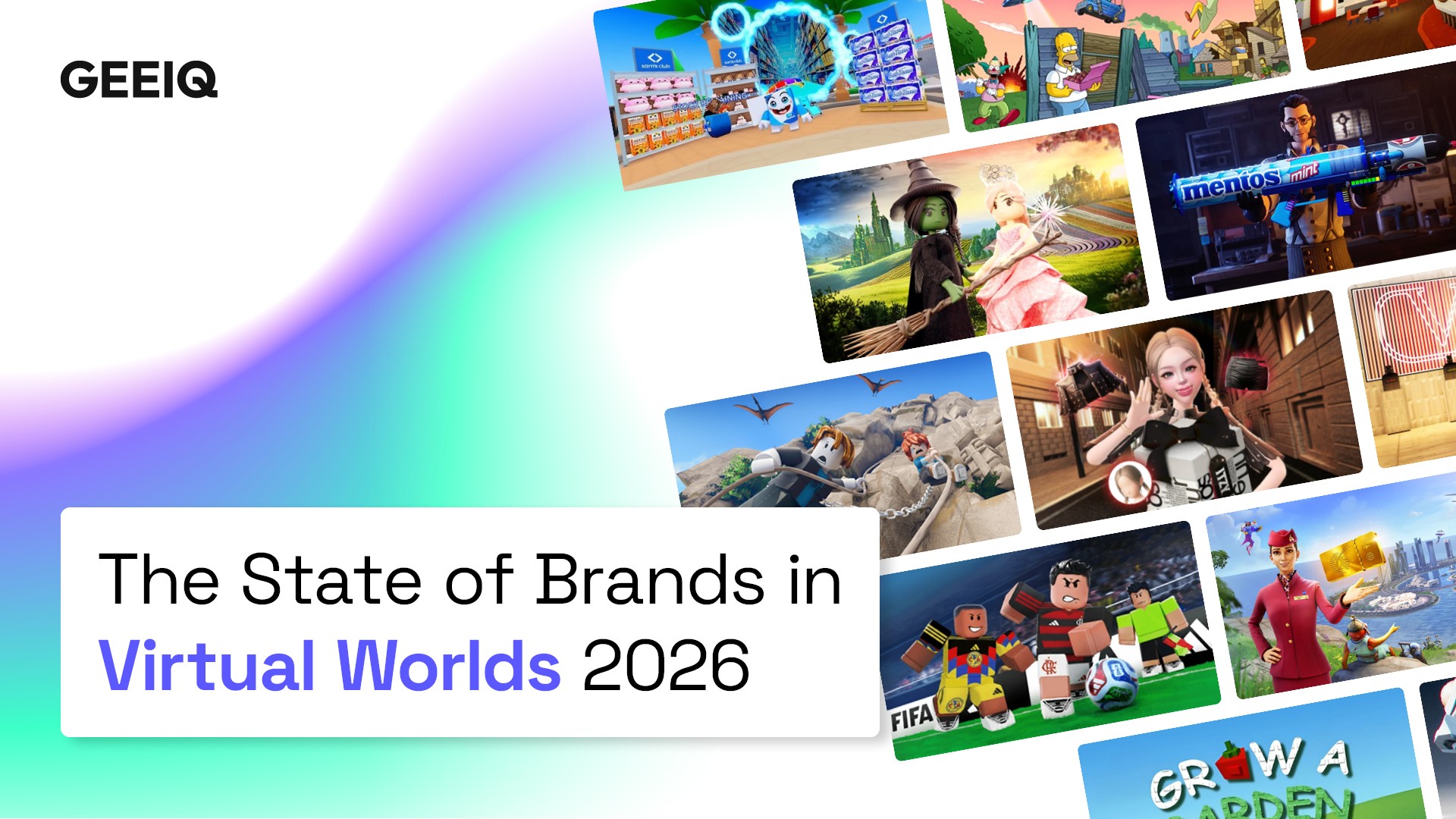
GEEIQ's State of Brands in Virtual Worlds 2026 data shows brands have taken this lesson on board. In 2025, brands launched 337 integrations into existing experiences and 252 brand-owned worlds, the first year integrations came out ahead. New owned worlds fell 57% year over year while integrations grew 16%, and 31% of brands that launched an integration had previously built their own world. Owned worlds still work for some categories, such as entertainment IP, where fans want to be part of the story.
Which platforms should brands prioritise?
Brand activity now sits on two platforms. Roblox hosted 65% of the activations GEEIQ tracked in 2025 and Fortnite hosted 23%. Together, they account for 88% of tracked brand activity.
GEEIQ links this concentration to proven reach and mature creator ecosystems. Both platforms also have established formats, so brands can build on what has already worked for others.
Concentration does not make the choice simple. As Hambro put it, 'You can't use a Fortnite strategy for Roblox'. Each platform has its own audience and its own creator community, so a plan built for one rarely transfers to the other.
Choose by audience fit. Start with where your target audience already spends time, then check which formats on that platform suit your product. The platform with the most activations is the wrong choice if your customers spend their time elsewhere.
How do brands measure success in virtual worlds?
Brand teams need numbers they can take to stakeholders, and platforms have started publishing their own. Roblox released its Roblox and Ipsos attention study in June 2026. In it, 52% of surveyed Roblox users aged 13–34 said they pay more attention to ads on Roblox than usual. That figure beat streaming by 13 points and social media by 11 points.
The same research found 63% of respondents say product information they see on Roblox is memorable. Roblox commissioned the study, so read it as a platform reporting on its own ad product.
Roblox also announced a partnership with EDO. Brands can now measure Roblox campaigns against the same engagement benchmarks EDO applies to linear and streaming TV. That puts virtual world activity into the language media planners already use.
Platform research covers one platform at a time. GEEIQ benchmarks each activation against everything it has tracked, so brands can compare an activation on Roblox with one on Fortnite on equal terms. To see where your brand already shows up, including unofficial creator-made content, start with a free Brand Gaming Footprint Check.
What are the main risks brands face when activating in this space?
A consideration Singh raises is the risk around users travelling between experiences with your branded digital assets. 'How can it be used in other worlds? That is something that's totally out of the brand's control'. He argues that this will become even more important when interoperability becomes more commonplace between these platforms.
'Moderation is also something to be cautious of, as brands offer creators and users an element of freedom when interacting with their brand', adds Tucker.
Finally, is the metaverse dead?
The word might be, claims Hambro, but people are increasingly spending time inside 3D virtual environments, and have been doing so since before the word 'metaverse' even existed.
'Maybe the word will survive, maybe it won't, it doesn't really matter' he adds. 'Brands are increasingly looking at these spaces with a different mindset, one that's not PR focused or campaign-based'.
'My prediction is that brands are going to continue to see these spaces as mainstream communications channels, rather than a shiny innovation exercise. Your virtual environment will become an institutional part of your brand in the same way that an Instagram profile is'.
The data since then supports the prediction. Brands launched an average of 1.8 activations each in 2025, up from 1.4 in 2023, according to GEEIQ's State of Brands in Virtual Worlds 2026 report. Fewer brands are launching one-off stunts; more are coming back.
Book a demo with
one of our experts
See how GEEIQ helps brands measure and grow virtual world impact