

Why are brands investing in gaming?
The short answer: brands are investing in gaming because that is where attention has moved. Gaming is the largest entertainment category in the world, worth more than music and film combined, and it holds attention better than any other channel. The audiences brands find hardest to reach elsewhere, Gen Z above all, now spend hours a day inside gaming and virtual worlds. And the data shows brands following: annual activations have grown 20× since 2020. What was once an experiment is now a channel.
Attention has moved through three eras. First print, TV, and radio. Then social media. Now, gaming and virtual worlds. Each shift moved spend toward where people actually spend their time, and the current one is why gaming has become a serious line on the marketing plan rather than an innovation side-project. (For the full marketing-mix argument, see The Third Pillar: Why Virtual Worlds Belong in Your Marketing Mix.)
Here is what is driving the investment.
Gaming is the largest entertainment category in the world
Gaming is worth $188.8 billion globally, more than music and film put together at around $61 billion combined (Newzoo Global Games Market Report, September 2025). That scale makes gaming a main stage for culture, not a side channel. It is where the next generation spends its time, builds its identity, and decides what is worth paying attention to.

Gaming is worth $188.8bn globally, more than three times music and film put together. Source: Newzoo Global Games Market Report, September 2025. Global market value in US$ billions.
It holds attention better than anywhere else
Attention is a scarce resource, and gaming commands more of it than any other channel. Nearly three-quarters of players are in a focused state while gaming (73%), well ahead of video streaming (57%) and social media (40%) (McKinsey Attention Study).
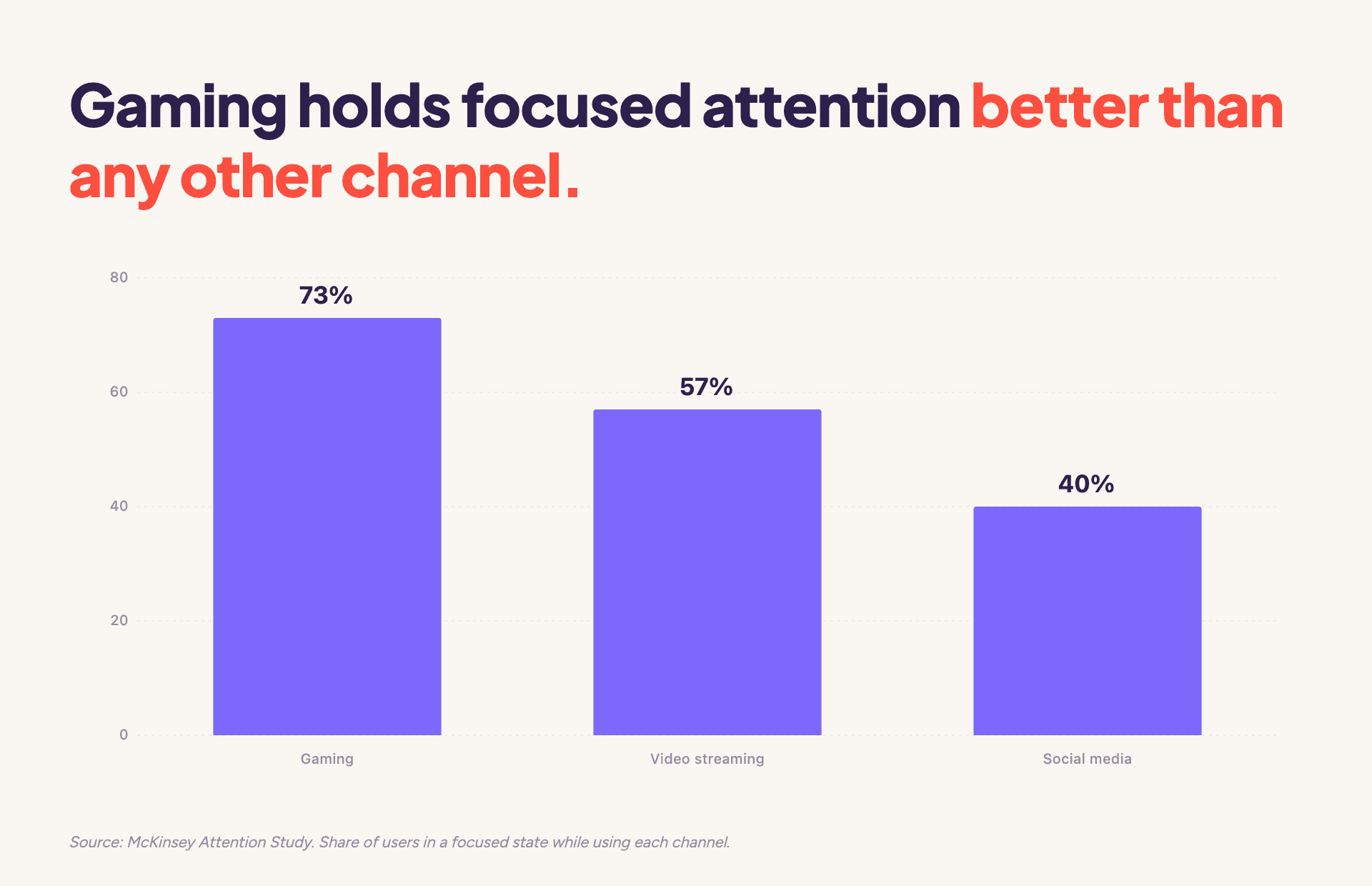
Gaming holds 73% of users in a focused state, against 57% for video streaming and 40% for social media. Source: McKinsey Attention Study. Share of users in a focused state while using each channel.
That focus turns into time spent with brands. A brand experience inside a game holds attention for around 11 minutes on average. The same audience gives branded content on social roughly 1.3 seconds before scrolling on (GEEIQ Platform; industry social engagement data). Eleven minutes is enough time to tell a real story. A second and a half is not.
The audiences brands struggle to reach are already there
Gen Z lives online, spending more than seven hours a day on the internet, yet the old ways of reaching them are losing their grip (Meltwater Digital 2025 Global Overview Report, GWI Q3 2024). Around one in three 16 to 24-year-olds use ad blockers. Short attention spans, heavy ad avoidance, and falling trust in traditional channels make this generation hard to reach through interruption, which is exactly what the old playbook depends on.
Gaming is the exception. Among 16 to 24-year-olds, 92% of women and 93% of men play video games, a near-universal behaviour. They are the only age group to consistently rank gaming among their top reasons to go online, and 17.7% engaged with a branded game in the past month, a higher rate than older generations. Reaching this audience now means showing up inside the experiences they choose, rather than the ones they skip.
Gen Z now spends more time in virtual worlds than on social
The clearest sign of the shift: Gen Z in the US now spend more daily time in a virtual world than on the biggest social platform. Roblox takes around 2.6 hours a day, ahead of TikTok at 1.5 hours (GEEIQ State of Brands in Gaming 2024; Insider Intelligence 2024). Roblox alone has an estimated 380 million monthly players, the largest of the virtual worlds.
Attention has not only moved into gaming. Within gaming, it is moving into virtual worlds the fastest. (New to the term? Start with what a virtual world actually is.)
Brands are following fast
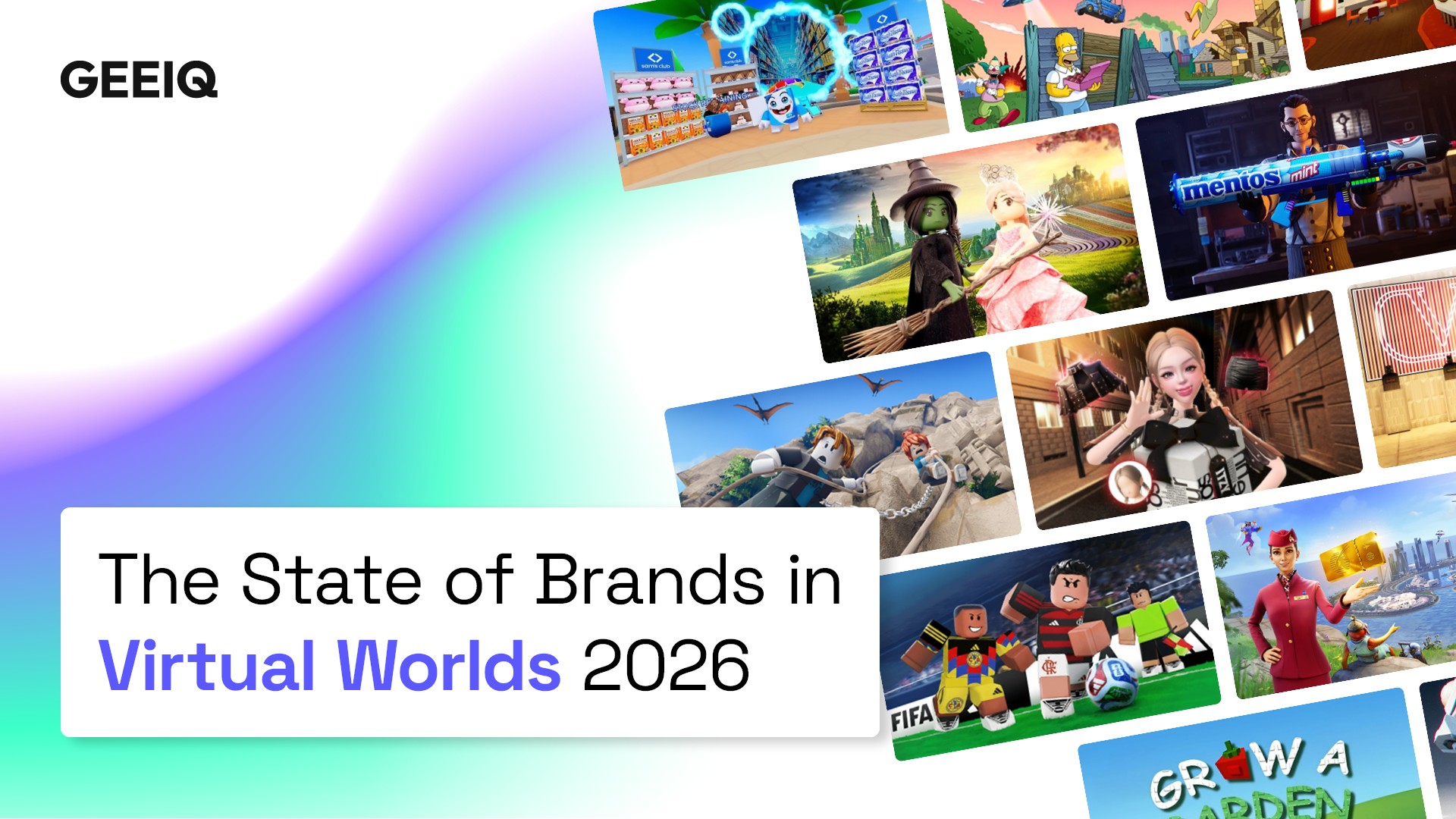
This is visible in the data. New brand activations in virtual worlds grew from 51 in 2020 to 1,011 in 2025, a 20× increase in five years (GEEIQ State of Brands in Virtual Worlds 2026). Volume eased 17% from the 2024 peak of 1,220, while commitment deepened: the average brand ran 1.8 activations in 2025, the highest on record.
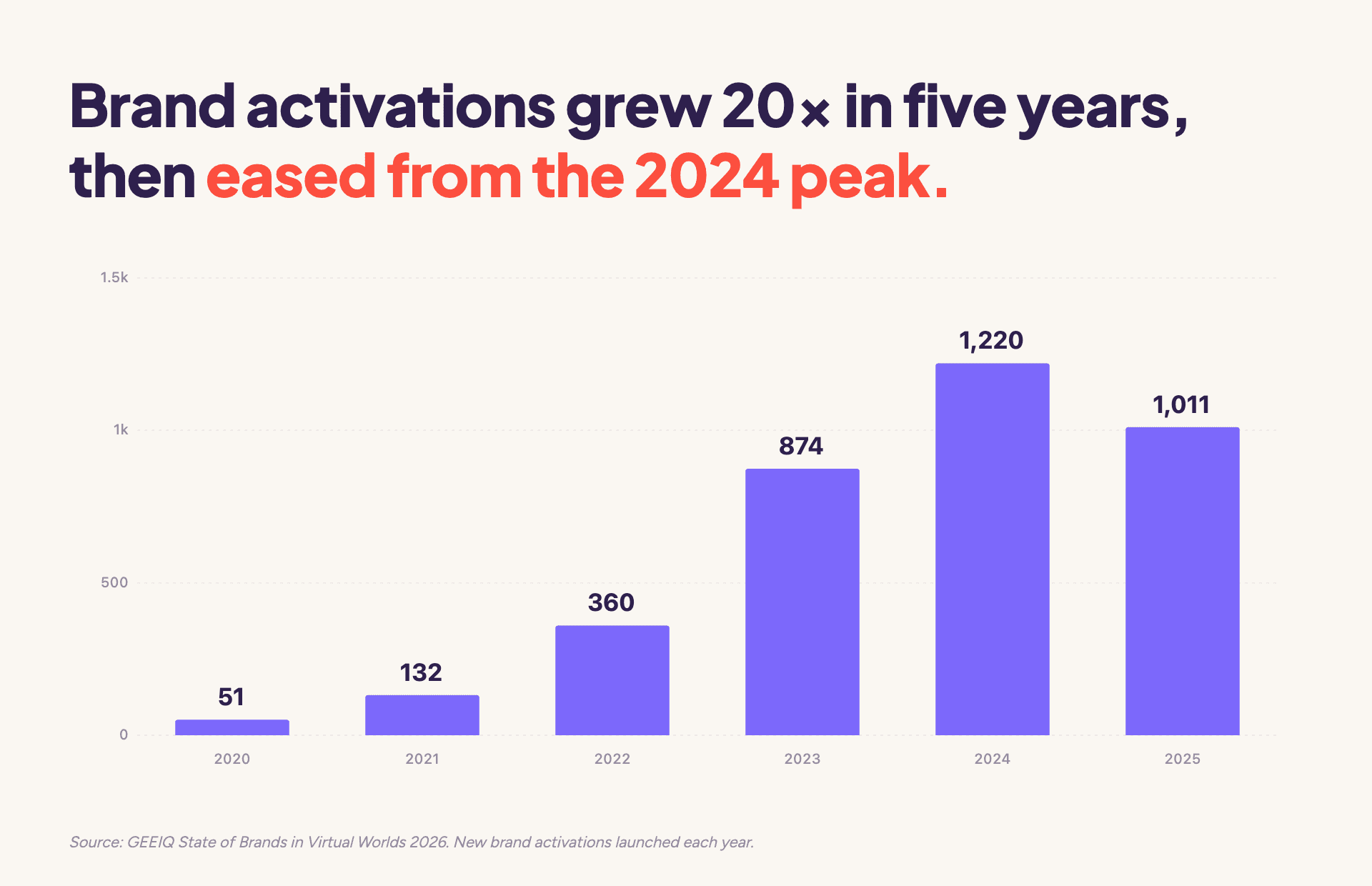
New activations each year: 51 in 2020, 132 in 2021, 360 in 2022, 874 in 2023, 1,220 in 2024 and 1,011 in 2025. Volume peaked in 2024 and eased 17% the following year. Source: GEEIQ State of Brands in Virtual Worlds 2026. New brand activations launched each year.
The market is maturing, too. More brands now enter through integrations, the faster and lower-commitment route, than by building their own worlds (337 first-year integrations against 252 owned worlds). Roblox and Fortnite together account for 88% of all brand activity. The space has moved from a handful of experiments to an established channel with clear leaders and repeatable routes in.
It works across the whole funnel
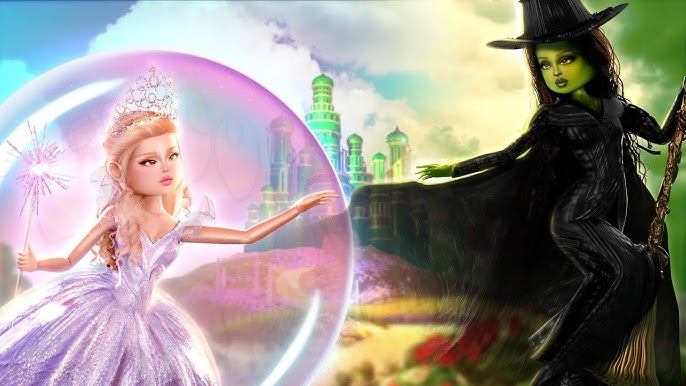
Virtual worlds support the full funnel, from awareness through to loyalty and sales. Brands use them to build equity and earn media, to hold attention for minutes rather than seconds, to collect first-party data, and to reach real outcomes. Walmart, for example, became the first brand to bring real-world commerce to Roblox. Recent work from Wicked, NASCAR, Elton John, and How to Train Your Dragon shows the same pattern playing out across entertainment, sport, and music.
The results are measurable. On-platform and off-platform signals can be mapped to each stage of the funnel, so the investment can be proven rather than assumed. (For how that measurement works, see what EMV is and why it matters for brands in virtual worlds.)
Where to begin
There are five ways into gaming: virtual worlds, IP partnerships, esports, creators and paid media. Virtual worlds are where attention is shifting fastest, which makes it the clearest place to start. The next decision is which platform fits your audience, since each has its own demographics and culture. (Which gaming platform is right for your brand?)
For the full picture, including how to frame a strategy and choose a format, our guide Brands in Gaming 101: Part I, Virtual Worlds covers it end-to-end.