Marketing to Gen Z and Gen Alpha means going where their attention already lives, and increasingly that is gaming. 90% of Gen Z identify as gamers (Deloitte, 2025 Digital Media Trends), while for Gen Alpha, gaming is the number one leisure activity, ahead of social media and TV. The playbook that worked for millennials, built on paid social, search and display, reaches a shrinking share of these audiences. This guide covers who these generations are, where they spend their time, why traditional channels underperform, and how brands are adapting.
Who are Gen Z and Gen Alpha?
Gen Z covers people born between roughly 1997 and 2012. In 2026 they are aged 14 to 29: students, early-career professionals and, increasingly, parents. They make up around 23% of the global population and hold real spending power.
Gen Alpha covers those born from around 2013 onwards. The oldest turned 13 in 2026, which means the leading edge of the generation is only now becoming legally targetable on most social platforms. Their influence arrives earlier than their income. Mastercard research published in February 2026 put Gen Alpha’s direct and influenced spending at $1 trillion in 2024, climbing towards $1.7 trillion by 2029.
Treating the two as one youth audience is a mistake. They differ in where they can be reached, who controls the purchase, and what regulation allows. But they share one behaviour that matters more than any demographic line: both grew up inside games.
Where do Gen Z and Gen Alpha actually spend their attention?
The numbers are unambiguous.
Gen Z: 90% identify as gamers, according to Deloitte’s 2025 Digital Media Trends survey. The ESA’s 2026 Essential Facts report found 78% of Gen Z make in-game purchases, at a median of $20 per month. They play across a layered stack of console, mobile and PC, and they watch as much as they play, following creators, streams and esports as part of the same behaviour.
Gen Alpha: eMarketer forecasts 51.2% of US Gen Alphas will be digital gamers in 2026, against just 22% using social media. Gaming time among children under nine grew 65% between 2020 and 2024, from 23 to 38 minutes daily (Common Sense Media). PwC’s 2026 survey of over 1,000 US children aged 7 to 14 found 42% already make in-game purchases with their own money.
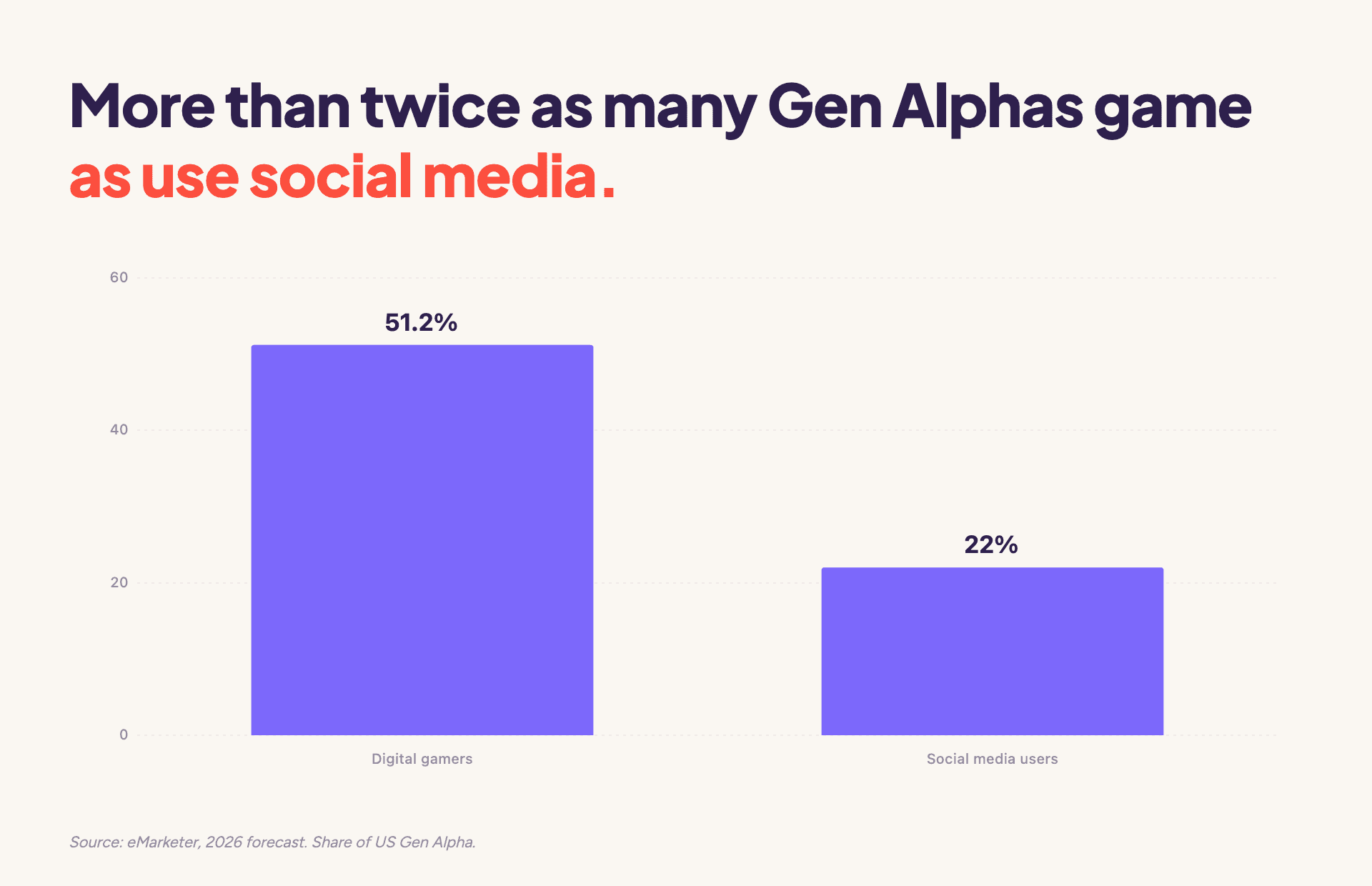
A media plan built on social structurally cannot reach most of this generation. Source: eMarketer, 2026 forecast. Share of US Gen Alpha.
The platforms: Roblox reported 132 million daily active users in Q1 2026, spending 31 billion hours on the platform in a single quarter, up 43% year on year. Among age-verified users, 35% are under 13 and 38% are aged 13 to 17. That is a concentration of under-18 attention no social platform can match. And the audience is ageing up with the platform: Roblox’s 18 to 34 cohort grew over 50% year on year and monetises at a higher rate than under-18s.
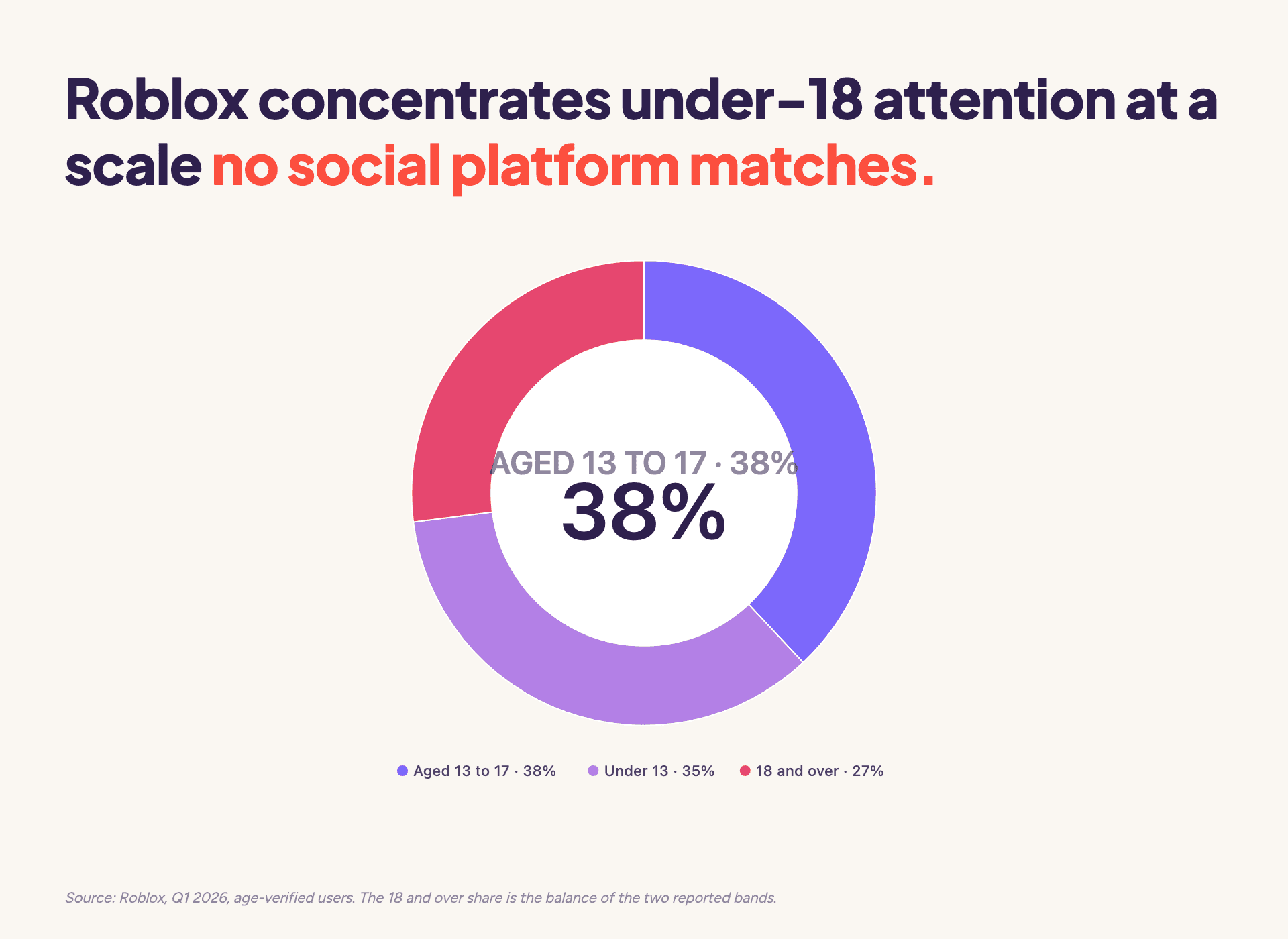
Age mix of age-verified Roblox users. Nearly three quarters are under 18. Source: Roblox, Q1 2026, age-verified users. The 18 and over share is the balance of the two reported bands.
Where brands go: GEEIQ platform data shows 88% of brand activations in virtual worlds take place on Roblox and Fortnite, with the bulk on Roblox. The reason is structural: UGC platforms allow open, scalable brand entry, where traditional titles gatekeep access. Minecraft is closing the gap. With over 600 million lifetime copies sold and a strong 8 to 14 and college-age audience, it launched its first affiliate programme in June 2026, giving brands structured commercial access for the first time. All three major UGC platforms now run creator revenue-sharing, which makes brand activity measurable across all of them.
For Gen Alpha in particular, platforms like Roblox, Fortnite and Minecraft are not entertainment channels. They are the places friendships happen. Marketing that treats them as ad inventory misses the point of why anyone is there.
Why do traditional channels underperform with these generations?
Three structural reasons.
Social media reach is limited or non-existent for Gen Alpha. Only 22% of Gen Alphas use social media at all (eMarketer, 2026), a function of age restrictions and parental gatekeeping. Australia’s under-16 social media ban, in force since late 2025, signals the regulatory direction. A media plan built on Meta and TikTok structurally cannot reach most of this generation, and as youth restrictions tighten, virtual worlds are emerging as the curated, moderated alternative. Brands over-indexed on social with young audiences should be planning that shift now, before the constraint forces it.
Regulation blocks behavioural targeting of children. COPPA prohibits collecting personal data from under-13s without verifiable parental consent, with updated compliance requirements due in April 2026, and the Kids Online Safety Act would add further platform obligations. Brands cannot retarget their way to Gen Alpha. Contextual presence inside the environments they already inhabit is the compliant alternative.
Gen Z has moved discovery away from search. Instagram and TikTok have overtaken Google for product discovery among Gen Z, and 40% have used TikTok as a search engine (Hootsuite, 2026). For gaming audiences the shift is sharper: creators are the primary way Gen Z discovers new games and, by extension, the brands inside them. HubSpot research found 61% of Gen Z prefer brands that work with creators over celebrity endorsements.
Repurposed advertising fares badly in both cohorts. These audiences grew up skipping, blocking and scrolling past ads. What they do not skip is content and experiences that give them something to do.
The platforms are now separating the generations themselves
Until June 2026, a brand experience on Roblox reached seven-year-olds and seventeen-year-olds through the same front door. That has changed. Roblox rolled out age-based account tiers globally on 16 June 2026: Roblox Kids for ages 5 to 8, Roblox Select for ages 9 to 15, and standard Roblox for age-checked users 16 and older. Accounts progress automatically as users age, and chat is gated behind an age check for everyone.
In practice, the platform has drawn the Gen Alpha and Gen Z line itself. That has three consequences for marketers.
First, reaching under-16s now has a higher bar. Games available to Roblox Kids and Select accounts must pass an extended review and selection process, and their developers must complete ID verification. Brand experiences targeting Gen Alpha need to be built to clear that process, and social hangout formats are excluded from the under-16 catalogues by default.
Second, creative has to work per tier. An experience designed for a 16+ audience will not automatically reach the 9 to 15 cohort, and the reverse is also true. One-size-fits-all youth activations no longer exist on the platform.
Third, measurement improves. Age-checked tiers mean brands get far clearer data on which age group an experience actually reached, which has been one of the weakest points in youth marketing measurement to date.
How to market to Gen Z
1. Build for participation, not exposure. Attention has not disappeared with Gen Z. It has become selective. They tune out brands that broadcast at them and engage deeply with brands that invite them into something, a pattern GEEIQ has tracked across activations like Samsung’s Demon Hunt experience on Roblox. In-game experiences, customisation, user-generated content mechanics and creator collaborations consistently outperform static placements. If the activation can be screenshotted, worn by an avatar or shared, it works harder.
2. Put creators at the centre of distribution. Creator content is how Gen Z discovers games and evaluates brands. The best-performing brand entries into gaming pair the in-game experience with creators who already have credibility on the platform, rather than importing celebrity talent from outside it.
3. Show up across the full gaming behaviour, not just gameplay. Gen Z plays, watches, streams and talks about games as one continuous behaviour, across console, mobile and PC. Presence can span in-game integrations, streaming sponsorships, Discord communities and esports. And it extends beyond UGC platforms: Pringles partnered with Xbox across four franchises in a multi-IP European campaign in 2026, an example of an FMCG brand using a console’s catalogue as media inventory to reach players where UGC platforms do not.
4. Respect value sensitivity. This is a generation under real financial pressure. Cost of living is Gen Z’s top concern (Deloitte, 2026 Global Gen Z and Millennial Survey). Free-to-access experiences, earnable rewards and genuine utility beat premium-priced brand merchandise.
How to market to Gen Alpha
1. Go where social media cannot. With only 22% of Gen Alpha on social platforms, persistent gaming experiences on Roblox, Fortnite and Minecraft are the most direct route to the generation at scale. YouTube is the complementary channel: two-thirds of Gen Alphas will watch it in 2026 (eMarketer), and Precise TV found Gen Alpha is more than twice as likely to recall ads on YouTube than on other platforms.
2. Market to the parent at the same time. Gen Alpha influences the purchase; millennial parents approve it. PwC found children research products and advocate for brands years before they have their own income. Messaging that addresses safety, quality and value for parents alongside appeal for children performs better than either alone.
3. Design persistent experiences, not campaigns. Gen Alpha builds habits around places they return to. A branded experience that evolves over months builds more familiarity than a four-week burst. Pepsi is one of the clearest examples GEEIQ tracks: four owned experiences and two partner placements across five platforms between 2022 and 2026, including presence on both Western and Chinese virtual platforms. Most FMCG peers have not matched that footprint. The brands winning with this generation treat their presence as a product with a roadmap, not a media placement with an end date.
4. Build privacy-safe by default. Any Gen Alpha strategy that relies on behavioural targeting of children is a regulatory liability. Contextual placement, creator partnerships and owned in-game experiences deliver reach without collecting children’s data. Roblox’s new age tiers reinforce this: reaching under-16s now runs through a vetted catalogue, which rewards brands that invest in compliant, purpose-built experiences.
What do the two generations have in common?
Enough to justify a shared foundation. Both are gaming-native, creator-influenced and allergic to advertising that interrupts rather than adds. Both discover brands inside feeds and worlds rather than through search. Both reward brands that show up consistently and punish those that arrive for one campaign and vanish.
The practical implication: a well-built virtual world presence reaches Gen Alpha today and stays relevant as they age into Gen Z’s spending power. Roblox’s fastest-growing and highest-monetising cohort is now 18 to 34. The audience brands built for children five years ago is starting to buy.
How should brands measure marketing to Gen Z and Gen Alpha?
This is where most youth marketing falls apart. Impressions borrowed from display advertising say little about whether an eight-year-old formed a brand memory or a nineteen-year-old moved closer to purchase.
The brands doing this well measure across three layers:
Engagement quality: visits, repeat visits, session time and interaction with branded elements, benchmarked against comparable activations rather than judged in isolation.
Audience verification: confirming the experience actually reached the target age group and geography, not just a raw user count. Roblox’s age-checked account tiers make this materially easier from 2026 onwards.
Brand outcomes: awareness, favourability and purchase intent lift, measured through platform-native or third-party studies.
Without a data layer across these, brands are choosing platforms, partners and formats on instinct. With one, gaming becomes a channel that stands up in the same planning conversations as TV, social and search.
Where to start
Marketing to Gen Z and Gen Alpha is not a question of whether to enter gaming. Their attention settled the question. The open questions are which platforms fit the brand, what format earns engagement rather than tolerance, and how to measure it credibly.
That is exactly what our Brands in Gaming 101 report series covers. Part I focuses on virtual worlds: how platforms like Roblox and Fortnite work, what brands are building there, what it costs, and how success is measured, drawing on GEEIQ’s eight years of tracking brand activity in gaming.
FAQs
What is the difference between marketing to Gen Z and Gen Alpha?
Gen Z (born 1997 to 2012) can be reached through social media, creators and gaming, and controls its own spending. Gen Alpha (born 2013 onwards) is largely absent from social media, protected by child privacy regulation, and reached most directly through gaming platforms and YouTube, with parents as co-decision-makers.
Why is gaming the best channel to reach Gen Alpha?
Only 22% of Gen Alpha use social media, while 51.2% are digital gamers (eMarketer, 2026). Platforms like Roblox concentrate under-18 attention at a scale no social platform matches, and contextual in-game presence complies with child privacy rules that block behavioural ad targeting.
How much do Gen Z and Gen Alpha spend in games?
78% of Gen Z make in-game purchases at a median of $20 per month (ESA, 2026). Among Gen Alpha, 42% of US children aged 7 to 14 already make in-game purchases (PwC, 2026).
What are Roblox Kids and Roblox Select accounts?
Age-based account tiers Roblox rolled out globally in June 2026. Roblox Kids covers ages 5 to 8, Roblox Select covers 9 to 15, and standard Roblox is for age-checked users 16 and older. Games available to under-16s must pass an extended review process, which raises the bar for brand experiences targeting Gen Alpha and improves age-group measurement for marketers.
How do brands measure success in gaming?
Through engagement metrics (visits, repeat visits, session time), verified audience data, and brand lift studies measuring awareness, favourability and purchase intent. GEEIQ’s Brands in Gaming 101 report covers measurement frameworks in detail.