Inside the Integration Advantage - featuring PureGym
Webinar
GEEIQ
About this session
PureGym chats about their first-ever activation in Roblox, from choosing Paradise RP to testing full-funnel performance.
Transcript
This transcript was generated from the session recording and lightly edited for readability.
Hi everyone. I’m Barney and I’m going to talk a little bit about integrations and go into a little bit more detail about the inflection point that you heard about earlier. 2025 was the year where integrations overtook owned worlds. And you might ask why was that the case? Layla’s already spoken very well to the cost efficiencies, the fact you can reach an already existing and engaged audience, but there are some other things going on as well.
And to really understand what those are, it’s important to take a step back and and examine wider kind of digital culture and trends. What’s going on in the world of influencers? who are creators? How do they differ? how are these trends that are existing outside of Roblox really informing what’s going on in the platform? And by doing so, you can really identify what are the best ways for you to engage as a brand that are going to ensure you’re received in a positive way.
Okay. So, 2025 was also a year where creator content overtook traditional media for the first time. So, what I mean by that is brands invested more in creator platforms than they did in traditional channels like TV, cinema, and news. And when I say creator platforms, I’m talking about TikTok, YouTube, and Roblox. And what these platforms have done is they’ve really catalyzed this power shift where individual creators are now generating vast amounts of engagement, influence, and building huge communities that just wouldn’t have been possible traditionally.
So, if we could sort of go back 20 years, the biggest or one of the biggest shows in America was The Tonight Show with Jay Leno. Every night it would get 9 to 11 million people watching it. But it took a huge amount of investment from NBC Universal to make that happen every year, etc. But we’re now at a point where these platforms have enabled individuals who started out in their bedrooms to grow communities and influence to the same size and in some cases even surpassing it. And what’s also really interesting is that, this isn’t just one or two big mainstream shows.
There are hundreds and thousands of these creators who are commanding this sort of influence. I don’t know if any of you know who the guy on the far right is. Does anyone know? Correct. Yeah, Shane Gillis. So he is a comedian and he also owns the biggest product on the Patreon platform in terms of monthly subscribers. So generating millions of engagements and views on his content every month. And no one in the room except for Harry has heard of him.
That’s quite interesting. What also happened last year is YouTube’s reach overtook the BBC’s in the UK. So for the first time ever, total reach surpassed that of any individual channel or service. And literally two days after this stat was announced, it the BBC and YouTube announced that they had partnered together. And why have they done that? Well, what this partnership means is that YouTube will help the BBC to make content that is native to the platform and feels endemic.
And then the BBC will take that content and also host it on their channels as well. So it shows the ways in which the way people are engaging with media is changing. Another thing that we’ve identified that’s happening is trust in traditional influences is falling. And I want to introduce a kind of a comparison here between traditional influences and the creators that Charles mentioned at the start of his talk. and I think the key difference here is it it comes down a lot to trust.
and we’ve all in our lifetimes experienced the the rise of influencer culture and we’re now at a point where there is saturation. And what we might call career influencers who have been generated a lot of wealth and a lot of influence through working with many many brands, they’re kind of losing their credibility a bit and their and their audiences are losing trust in the content they’re creating. It is feeling a bit transactional and so creators are kind of emerging as more authentic voices. And another reason for that is just the growing demand for authenticity and relatability. I would say that the detectors of young people today have never been higher and brands really have to understand even more than ever, being authentic, being real, being credible is so important if young people are going to engage with you.
So, creators have really emerged as the cultural leaders of the last 6 years. This is a very recent movement, but it has transformed the industry. I want to speak through an example again with the BBC here. this speaks to a video game many of you may have heard of called GeoGuessr. It was released in 2013. this guy, Tom Davies, known as GeoWizard, created a YouTube channel from his bedroom making content about this game.
He became really really good at the game, generated a lot of subscribers, and then he started doing these new kinds of videos where he’d actually go out into the real world and play GeoGuessr in the real world. If any of you haven’t played it, it’s essentially you’re planted somewhere in the world and you have to navigate and find where you are. So, the BBC saw this and they liked what he was doing and they created a show called Destination X, which was entirely based on his content. When it came to releasing the show, they then recruited him as a key ambassador to introduce the concept to his community. So, a final thing that we’ve identified that was that’s going on here is that social media is becoming less social.
And Charles often talks about how in the past, 20 years ago, we used to refer to social networks because that’s what they were. They were networks of people that you knew or had met and you wanted to stay in touch with. Now, we talk about social media and it’s really because these platforms have become content channels, media channels. And young people are starting to spend less and less time on these channels, particularly when it comes to socializing. There’s definitely a kind of content fatigue going on where people are looking for more personal connection, more community versus stimulation and consumption.
So, to kind of summarize what’s going on, three key things I want you to keep in mind. First things first, social is high volume but low meaning. It at the as it stands, these platforms are optimized for scale but not for connection or meaningful participation. UGC has caused a power shift and culture is fragmenting into these hundreds of different niche communities. And finally, not all creators are equal.
Scripted and transactional content from these career influencers is losing out to more authentic creator-led content. And what we’re seeing is as a result, attention is shifting, influence is shifting, and the ways in which we trust our creators are shifting. What this is resulting in is a huge boom in UGC-first platforms, whether it’s Patreon that I mentioned earlier, Substack for written content, and Roblox, which saw tremendous growth in the last year, 70% year-on-year. And surprise, surprise, this shift is happening in gaming. We’re going from a place where massive billion-dollar publishers like Activision Blizzard were creating games with huge development costs, very long lead times, and what I call top-down development in terms of they create the game, you buy the game, and that’s what you’ve you’ve got to play with.
Now we’re at the point with platforms like Roblox where you have these tiny little developers creating games in a matter of months that are that are generating as much if not more engagement. And there’s much more of a sense of co-creation between these developers and their communities. They they are members of the community themselves. So it’s the platforms that are making this creation easy that are really capturing the attention. And again, I’ll highlight the stat Leila showed about that day in October where one Roblox experience had twice as many people in than the whole of Steam.
Some really interesting data that came out just last week from Matthew Ball who wrote that famous book Metaverse. what we’re seeing is that single Roblox experiences are actually outperforming entire publishers. So I apologize, it’s small, but you can see here this is all titles that Activision Blizzard create. And they are losing out to Grow a Garden on average monthly hours of engagement. And in fact, every bar there that you see in red is a Roblox experience.
This would have been unprecedented to think about 5 years ago, and it’s happening now. So let’s take a pause. I think it’s very clear that given what’s going on these UGC platforms are where you need to be. That’s where the attention is. But again, when you come to thinking about how you activate on the platforms, you have that choice, owned world or integration. And again, owned worlds of course have their place, and I think particularly for media and entertainment and IPs, they will always have their place.
But, it’s a very difficult challenge when you think about what’s actually going on in the platform. So, on Roblox at any given time, there are 14 million people playing. Over half of them are spending time in the top 50 experiences. Now, there are over 6 million active experiences on Roblox. The top 50 accounts for 0.0007%. So, that’s a big challenge for brands to have to deal with. They’re competing with those top 50 experiences that are that that hold all of the engagement, basically.
What are these experiences like? Well, they’re hyper native. They’re very trend based. They’re constantly evolving. Just 2 months ago, this new brain raw experience entered the platform, as if we needed any more. And is already the top experience in the last 30 days when it comes to average CCUs. And again, this is not a unique challenge to Roblox. You will have all confronted this on social channels. Your brand owned channels do struggle to compete with the engagement that influencers get.
And it’s why co-authored posts drive 2.5 times the engagement. So, while media and entertainment IPs are best positioned to succeed within owned worlds, even in that case, there’s a large engagement variance when compared to these community made experiences. So, that’s the challenge that that that you have to think about before coming to the platform. It’s a big reason why we’re seeing the rise of integrations. Later, I spoke into the data here.
Interestingly, 31% of brands that have activated multiple times on Roblox and Fortnite did owned worlds first, and then started doing integrations. So, as has already been said, we really do see integrations as the creative marketing of virtual worlds. And those themes that I was talking about earlier about trust and authenticity, about community co-creation,
that’s how to achieve that most effectively on Roblox and Fortnite, it’s by doing integrations and it’s been working directly with those developers who know that community better than anyone. It also affords you the ability to predict results. it is absolutely more cost-effective. You can iterate quicker. it’s very well suited to campaign or product-led initiatives as opposed to brand. This is an example of one of our clients who did a known world and an integration in the same year.
And when you look at metrics like cost per visit, cost per minute engaged, you can really see the cost efficiency here that integrations drive. And we actually did a comparison with a parallel TikTok campaign that was running at the same time, and it was 2.9 times more cost-effective. In other words, they would have had to spend three times the amount on TikTok to generate the same engagement that they did on Roblox. What we’re also noticing when it comes to brands and integrations is that there’s a current over-reliance on experiences that either Roblox or perhaps your agency partner have recommended to you. Brands are being shown the same 20 30 experiences, perhaps because they’re well-established, they’ve done lots of integrations in the past, but often they’re not the right ones for many different reasons.
And there’s an entire ecosystem, hundreds of thousands of other highly engaged communities that you should be at least considering. In the same way that you wouldn’t want to be shown the same 20 influencers every time you’re doing an influencer campaign. What we’re also seeing, and again, it’s to do with that previous slide, is that brands are often not get that not getting the communities that they’re paying for. You might be introduced to a partner experience, and 4 months later you deploy your activation, but in that time frame, given how fast the platform moves, the number of people in that experience has dramatically dropped. So, you’ve paid for something that isn’t there.
So, by evaluating this entire ecosystem of various experiences, there’s more originality, there’s lower costs, there’s more likely to be a higher audience overlap, higher authenticity, and that’s going to create better sentiment and better results. Geek’s integration network and Geek’s geo integration feature really serve to fix the current model and the fact that brands, developers, and the entire ecosystem are losing. And you can speak to the guys in the room in more detail about what these two things are. Okay, a couple more slides. Busy, I know, but really this speaks to forecasting engagement on Roblox and what Geek is doing whereby we’re standardizing how much it should cost to engage a certain number of people through integrations.
So when you’re doing an integration, you’ll you’re going to be considering, do I do a very light touch module into an experience? Do I do a full takeover? And what size of experience should I go into? And each will have their own different costs associated, but what we what we can tell you is how much you should be paying and also how many people you should be expecting to engage. And finally, KPIs. This has been called the mega funnel internally, which I know is a lot to take in, but essentially we are also standardizing the metrics to measure success with integrations.
What we can do is we can tell you you you can see how many impressions you got, you can see how many brand area visits you got, you can see how many mini game starts there were, but crucially, we can tell you how that performs against the industry. How efficient was it? How does my cost per visit compare with the industry, with competitors? And these are the equivalencies that Geek has to empower you to understand how well you did. Thank you very much.
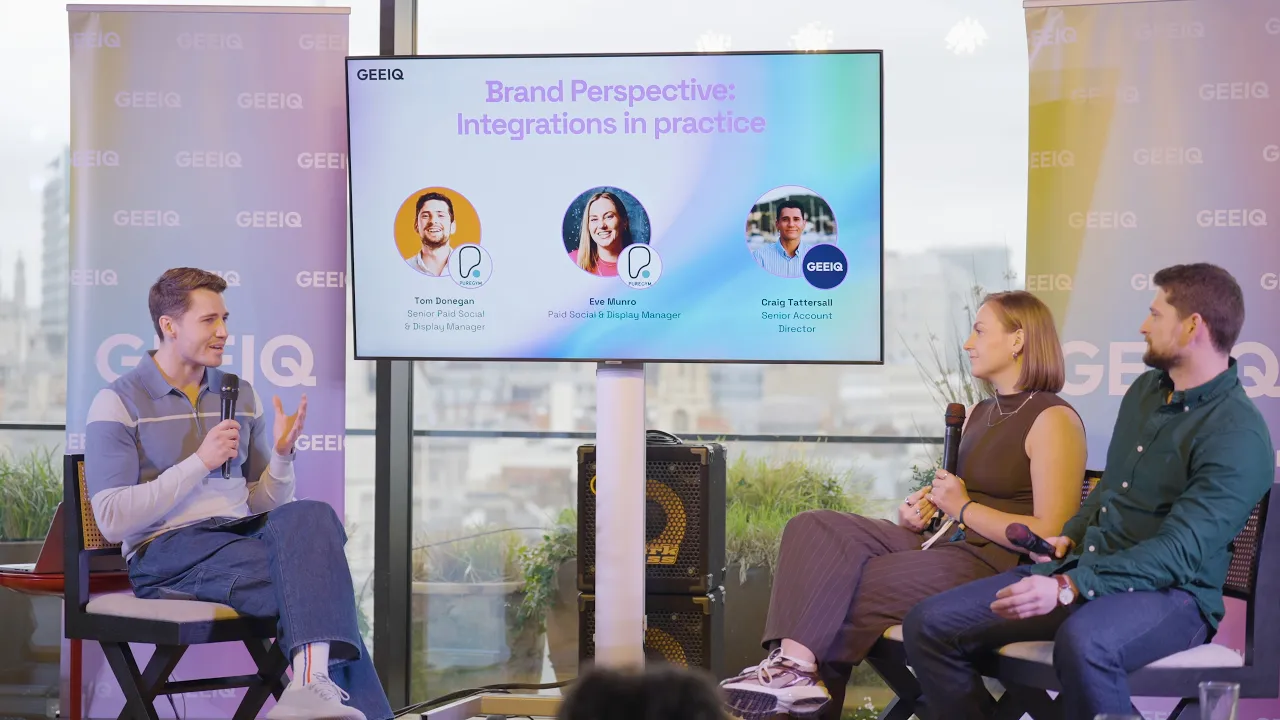
that was fantastic. Okay, we’re going to move swiftly on to the next part of this, which is really exciting for me because this is a brand that is very focused on integrations. It’s a UK-based brand and Craig is going to be presenting and and and moderating with Tom and Evie from PureGym. So, come on up, guys.
There we are. So, I think we’ve heard a lot today from from Leila, from Barney, from Charles about of course the rise of integrations. But, we’ve got we’ve got a new brand here. We’ve got PureGym. And I think initially I want to ask a question about like why virtual worlds, why now? I think it’s a bit of a to some people it might seem a little bit of an oxymoron, between gyms, virtual worlds, gaming. I guess what sparked the decision to explore Roblox for PureGym.
Evie, I’m going to come to you. Yeah, so I think for us it kind of came about quite naturally with so our digital marketing director attended a talk, I guess not dissimilar to this, about the kind of growth in virtual worlds, which led to a bit of a deeper dive internally, and the kind of opportunity for brands. I think one of the standouts for us when we did that was the kind of how prominent these spaces are with Gen Z and Gen Alpha in particular, which I think is a real focus area for us and kind of presented an opportunity when we especially when we kind of compared the amount of time that Gen Z especially was spending in Roblox versus TikTok where we’re already investing really heavily, then it kind of presented a really great opportunity to meet them where they’re actually spending the most time. So, it was kind of that on the one hand to to meet Gen Z where they are and in a bit of a more like fun and engaging way. But, I think as well it aligned really nicely for us with our new brand campaign of Feel Pure Gym Good which the kind of ambition of that campaign is to kind of break out of where you would typically see gyms activating and focus more on the the feeling and bringing that feel good rather than necessarily like gains.
So, I think that’s where Roblox really aligned as well because Gen Z especially are going to these spaces to feel good and that was obviously one of our main objectives with this new campaign as well. Yeah, so really about like actually reaching that next generation of Pure Gym Pure Gym members there. And I suppose that brings us nicely onto like and Tom, could you take us through a little bit about what like Pure Gym’s core objectives were in the space? Like what were you trying to achieve going into Roblox? Yeah, of course.
So, I think we approached this as a very much a test and learn situation. First mover in in within the gym space to kind of try out virtual world. So, it was very much test and learn. How can we use this short burst of time which was a two-week activation to learn as much as possible. So, we focused on a I would probably phrase it as a full funnel activation. We looked at reach metrics, consideration metrics, and then also we distributed day passes to people playing the mini game as well as promotion codes as well which were personalized.
So we covered quite quite a lot of different things in terms of how can we really get the most learnings out of this? Yeah, nice. And so like so we’ve established why why we’re in this space, why why Pure Gym is entering Roblox, but why if was an integration the option for Pure Gym, why not a standalone experience? Yeah, so I think as Tom said it was very much a kind of test and learn approach for us. So it very much an integration kind of presented the opportunity to to activate with kind of a lower lift, lower budget, so lower financial risk as well.
And also kind of get that guaranteed visibility cuz you’re tapping into that audience that already exists. But I think on top of that we kind of we were able to tap into the audience and kind of make sure that really aligned with who we were trying to reach. But we were also able to tap into the creators like expertise and understanding of their community. I think especially being kind of the first gym brand in this space it almost and like you said it could seem like not necessarily a natural fit. But by doing an integration and working with the creator Francis we could kind of work with him to really understand his community and make sure we were putting something out there that felt like it did fit and it felt seamless and was kind of adding value and something that people would actually want to kind of actively engage with.
Yeah, so very similar to working with a creator, a TikTok creator for example. You go they have the audience you want to obviously create content that feels native to that audience, right? And I suppose when we just saw a video there of of of the the game Paradise RP and Pure Gym’s activation there. What felt strategically right about placing Pure Gym inside that type of experience which is a role playing experience? Tom, could you answer that?
Yeah, I think I think it helped that it had a gym in there already. So, I think it it felt quite authentic in terms of how can we brand this as a Pure Gym, expand it out, create into mini games. I think that was helpful. But But it was really demographic led. Eve mentioned earlier, one of our target audience is very much Gen Z, Gen Alpha. And being the market leader, our job is to kind of grow grow the market.
so, I think working with the Geek team to understand the demographics, the data that sits behind each experience allowed us to kind of map that with our target audience. Nice. Yeah, and then through to I guess now thinking about like the the result side of things, when we go into that planning and execution stage, what what would what before you launch, like what would success look like for Pure Gym? And like what did you do to approach a success measurement framework? So, I think we we worked quite closely with with yourselves, didn’t we, in terms of, what what are the key KPIs that we’re looking at.
I think we never really expected this to drive direct memberships in terms of thousands of people to sign up to the gym. But what we did kind of expect is increased brand consideration, increased favorability as a result. And I think it really delivered on that in terms of cost efficiency. If we were to compare the channel at a, CPM level, obviously, social is much more it’s much cheaper to deliver ads. But actually, if we’re looking at the time span, it’s it’s incredibly efficient.
So, I think on average it took people played for 2 minutes at a time. which is a lot of time. And I think that’s active participation. That’s not someone viewing a viewing an ad, that’s someone engaged in the brand and enjoying the experience. So, yeah, I think su- super impressed with the consideration-based results that we saw. Yeah, I think we had sort of 2 minutes playing the actual mini-game itself.
And then we had obviously there was a branded area, and then obviously they’re engaging with characters that Pure Drive created for their latest campaign, which is really cool to see, characters taken from your TV campaign actually brought into Roblox in that space as well. Eve, I’d love to like talk about like the the planning process a little bit. Like based on, coming into this this world for the first time and like planning an activation, like what surprised you about the planning process and like what have you learned from that process from, choosing Roblox, starting the experience to where you are now? yeah, I think there’s a few things. So, in terms of the actual planning process, I think working with you guys to really understand the platform cuz it it was a completely new space for us as as a brand.
We’ve never kind of done anything in this space, and it’s not anything that I’d ever worked on before. So, I think in terms of the the level of insights that you have cuz it was such an unknown world to me. Like working with you guys on it, there’s so much data out there and so much insight that you can actually tap into to kind of get really great understanding of what kind of other brands have done previously that works well, what experiences are out there, what different audiences the different experiences have so that you can really make sure that it’s like tailored to what you who you want to reach and what you want to achieve. so, I think obviously it’s kind of like a nice surprise that there’s that much data that you can really kind of tap into to make sure your kind of planning and and creating something that really like fits. Yeah, nice.
And then that leads on to like I I I’d love to hear from both you on this actually, but thinking about some of the early results and some of the learnings you’ve got from from from this first activation. Like what’s been most encouraging for you, Tom, about the the whole process and some of those results? So, the the key stat I absolutely love about the campaign was that 85% of people said that they would consider PureGym as a brand while playing the experience. And I think that that’s absolutely incredible in terms of moving the dial on brand consideration, which was a core objective for us. So, yeah.
Probably yeah, less less top of funnel, less bottom of the funnel, but a real sweet spot in terms of that consideration aspect. Nice. And Eve, what’s what’s been most encouraging for you about some of those processes? I think for me one of the standouts was so, while our activation was live, we saw a 90% increase in average daily likes of Paradise RP. and that I think just showed how receptive players can be to these branded experiences when it feels like it’s kind of adding value and it it fits in kind of a non-intrusive way.
So, I think yeah, it was just really nice to see that people are really open to actually actively engaging with brands. Obviously provided it feels like it’s kind of they’re getting some value from it as well. so, yeah. Yeah, I love that. I mean, it really speaks to brands needing to show up authentically in the space. I mean, naturally you think a brand showing up in a gaming environment that would actually have like a negative sentiment.
And yeah, we tracked that actually had a positive sentiment. People loved seeing a brand that they liked show up in the space in a really sort of authentic way. And like now just think final question I’d love to hear from both of you around like, what’s next for PureGym, but also like what advice would you give to a brand like planning their first integration? Tom, I’ll come to you first. Yeah, sure. So, I think keep keep it really fun.
Keep it engaging for the user. I think think about the player first. You want it to be authentic. You want them to actually enjoy the experience, and that’s going to help when it comes to how they view your brand. I think just on the branding point, make sure that you’ve got distinctive assets within that mini-game as much as possible. So, we have the branding absolutely everywhere. We had the Feel Pure Gym good logos there at the end of the marathon.
Introduce UGC as well, so give something back to the players that they’re actually going to enjoy and can take into other experiences. So, yeah, I think focus on the on the player first and I think that will My mic’s gone. I think focusing on the player is probably the the key advice for for me for anyone looking to launch an experience or brand world. Amazing. And Eve? Yeah, I think I’d probably agree with that that kind of almost prioritizing fit of the experience over necessarily reach.
I know when we were planning there was some that were kind of had a bigger UK audience for example, but in terms of us showing up in those spaces it would have felt a bit random. So, I think kind of prioritizing the the fit and making sure that you do really like Pure Gym showing up in that in Paradise RP made sense. So, I think that’s one. I think the other for me from kind of what we’ve learned, obviously as Tom said we went in very much with almost like a full funnel approach, which I think given it was our first activation and we were trying to learn as much as we could in a really short space of time, then it was it was good in one sense, but we were almost trying I think to achieve a little bit too much and actually activating again, I think if we were to go in with like one really clear objective, which I think we’ve now learned is probably that consideration stage. Then we’d be able to kind of spend the time and budget a bit more efficiently without trying to do everything all at once.
So, yeah, that’s probably what I’d say. Totally agree on that and I think just a final advice piece of advice as well for anyone wanting to launch it would be around amplification. I think we worked with some influencers off the back of it to kind of extend that reach beyond Roblox and that platform and we looked at sort of TikTok, Instagram, even Twitch was was considered. So, I’d say make sure that you leverage other platforms to maximize the reach. Yeah, have that sort of 360 activation, multiple touch points, all that sort of stuff.
Beautiful. Well, thank you very much, both of you. Really good to hear. Thank you. THANK YOU.
GREAT STUFF. THANK YOU. OKAY, UM WE NOW come to the end. So, final thank you to you all for coming. Thank you to the speakers. Thank you, Warner Brothers. Thank you, PureGym. Thank you, Bonnie, Layla, Craig, and everyone that’s contributed. And of course, Hayley who’s organized the event. Thank you, Hayley. Round of applause for Hayley.
I will close out by saying I hope you’ve all learned something today. I hope that the report has given you a new perspective in terms of what to look for for 2026. Of course, we will be back for 2027 support next year. right, I’m going to leave now. Thank you so much. Thanks, everyone.