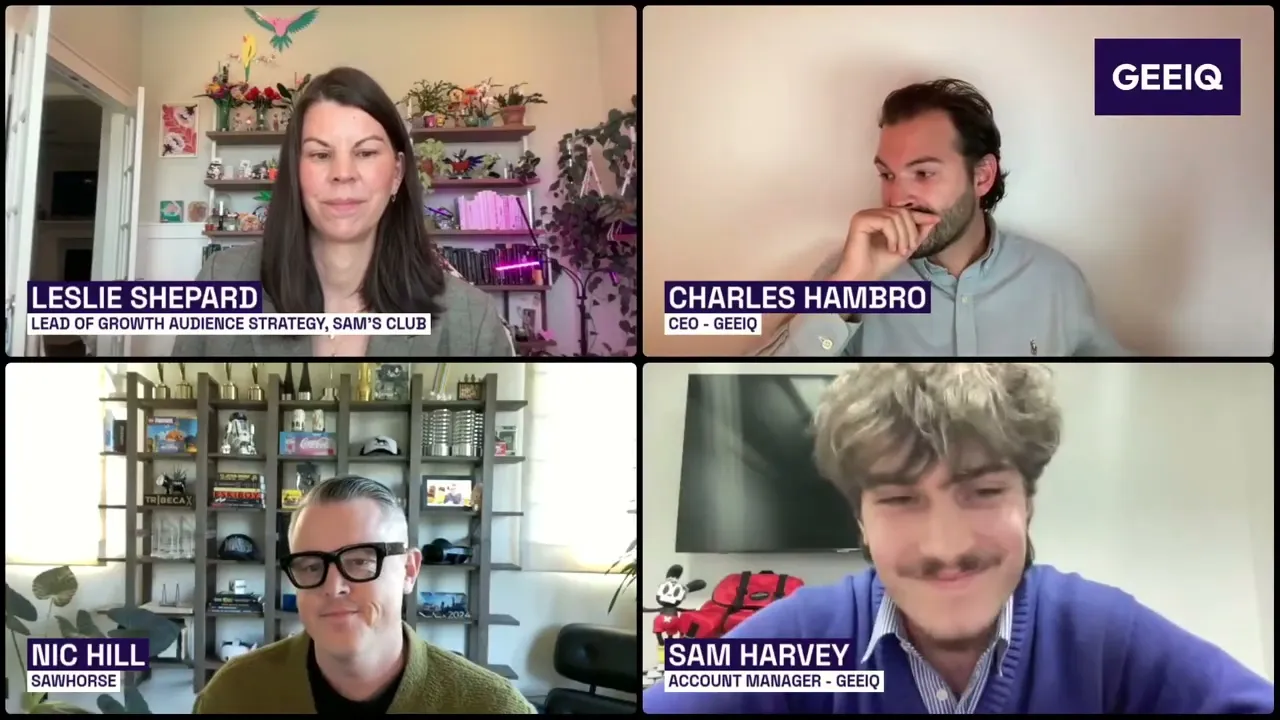
How Sam's Club won over Gen Z
Webinar
GEEIQ
About this session
GEEIQ webinar, October 2025
Transcript
This transcript was generated from the session recording and lightly edited for readability.
Okay, we are live. Welcome everyone to this webinar. Very excited to be here. We’re going to talk about how Sam’s Club won over Gen Z and Gen Alpha, and I am delighted to be joined here today with the people that really made it happen. So, we’re going to start here with a round of introductions. I’ll start with myself for those of you that don’t know me. I’m Charles Hambro, CEO and co-founder here at Geek.
And I’m going to hand over to Sam first. Sam, not from Sam’s Club, but Sam from Geek. he is going to introduce himself, and then and then we’ll go on to the next after that. So, Sam, why don’t you just introduce yourself? For sure. Thanks, Charles. yeah, hi everyone. my name’s Sam. I’m an account manager here at Geek. Obviously, supporting on the Sam’s Club account. I’ve been at Geek for around 3 years, supporting brands with their gaming and virtual environment journey.
supporting across kind of luxury, fashion, apparel, but also obviously retail, and increasingly, entertainment brands as they come into the space. yeah, super excited to dive into this campaign and, share some hopefully nuggets of wisdom as we go. I think Leslie, I’ll I’ll pass over to you. Can introduce yourself. Thanks, Sam. Hi, everybody. I’m Leslie. I lead the growth audience strategy at Sam’s Club. I’ve been at Sam’s Club for almost 7 years on the marketing side.
I am an avid video game player in my personal life, and I have a 13-year-old and 16-year-old sons that also play a lot of games. And so, this activation and the strategy is a personal passion of mine as well. love the space and the partnership with everybody here, and I’ll pass it to Nick. Awesome. I’m Nick Hill. I’m co-founder and chief innovation officer of Sawhorse. Sawhorse, we’re a creative agency that tells brand stories.
We’ve been around for about 15 years. So, we do everything from video content, social content to immersive gamified experiences for brands, and super excited to be here. Really love working on the Sam’s Club project with the GEEKS team and the Sam’s Club team. And yeah, looking forward to unpacking it here. Excellent. Thank you, guys. Okay, so we can basically dive straight into What I want to say to the listeners is you’ll see a chat feature where you can put in your questions.
So, any stage during this webinar, put in your questions. We’ll either kind of get to them immediately or we’ll get to them towards the end of of this webinar. I’m sure there’s going to be a lot of things people are interested in with this particular activation because the first thing I want to say is if I think about Sam’s Club, it’s it’s sort of cousin to Walmart, and Walmart has been very active inside gaming and virtual worlds. and I suppose the first question I want to get to is really Leslie in terms of the why. We always want to think about the why.
Sam’s Club, I I was just looking at GEEKS data. They’ve actually done some activations in Obsess before with some sort of virtual shopping. tell me, Leslie, what was it that brought you to Roblox as a place that you want to engage in and play in? And what’s the sort of top level objective? so, it started actually probably about 3 years ago looking at the space. and a leader at the time had introduced me to GEEKS in terms of leading a gaming strategy.
And it started first with just seeing other brands activating in the space. Walmart, like you said, has been in the space for quite a bit of time. And then, that that is an idea, but would it work for Sam’s Club? So then looking at the Sam’s Club data in like this year and last year, Gen Z is our top growing generational membership. But before that, 3 years ago, it was not. So our our base averaged a little older than the US population.
So we were like, how can we reach Gen Z consumers and then drive that relevancy and that consideration? And then of course, if you do any internet searches or now chat GPT, you can see that Gen Z spends most time in games than most other platforms. a lot of time spent and are there in the masses. And so if we really wanted to reach this audience, gaming and Roblox makes the most sense because of the volume and the time spent. So it was really just trying to find a platform to reach an audience where they are in the masses.
And you had mentioned obsessed, which is a great tool to do a lot of test and learn on the e-commerce side with an immersive experience. The challenge there is that you have to also then drive the audience to it. You have to drive the traffic. Where the traffic we are trying to reach already exists in Roblox. And I think that’s we’ll get into how actually interwoven with your strategy is about reaching players where necessarily not not even building your own world, but going into worlds that already exist, which is very interesting.
going back to what you said there. So it’s really interesting to hear that actually Sam’s Club core core demographic, I suppose, would have been millennials. and there are different platforms to really interact with the millennial audience. I’m thinking of traditional social media like Instagram and and Facebook and and X. But since your demographic is evolving and changing and Gen Z are becoming a more and more core target for memberships at Sam’s Club, you’re absolutely right.
It sounds like you need to meet them where they are and they don’t necessarily hang out in the same environments that millennials hang out in. So that brought you to kind of gaming and Roblox in particular being a very large platform in the gaming space. Tell me and and maybe this is both to you Leslie and and and Sam. when you first started embarking on this journey with actually a lot of learnings from other brands in terms of what they’ve done, what was your I suppose top level objective we need to reach Gen Z and Gen Alpha where they are hanging out. How did you formulate the strategy that you came to and then maybe after that we’ll start to go in with Nick about what what that actually was in the end.
So how did you what was the process of formulating the strategy? I I remember lots of workshops and lots of strategy calls with Sam and team about how we can activate in Roblox for Sam’s Club and there’s a couple pieces that went into it. One was wanting to create a flywheel where it was beneficial for the developer, beneficial for the player and the brand when these integrations happen. cuz and I’ll say that very transparently is that since our brand is perceived to be for an older audience and several years ago we had a more mature audience that a lot of developers weren’t interested in partnering with Sam’s Club at the time several years ago because How interesting. Yeah, the alignment they felt like wasn’t there for their audience and our audience.
And so the perception of the Sam’s Club brand was just like this isn’t for us. Is that is that Yeah, well I mean my mom shops there or like I remember I I shopped there with my grandma, but I don’t necessarily for me myself as a consumer think that I would likely be to shop there. So, Sam and I were talking about like, okay, well, how can we create a strategy that gets developers as excited that Sam’s Club wants to partner with them as the player. And so, that’s kind of where integrations came from is like, we’re trying to find an audience. These titles have the audiences that we want to reach.
And so, how do we make sure that the developer’s excited, Sam’s Club’s in there, and that’s through paid media and other ways that we’re going to hopefully drive even more traffic to their experience while we’re there. And then reward the players for engaging with the brand with UGC. I I saw on your guys’s dashboard how much UGC is issued per brand, and then, we went back and forth about how much money should we invest? And I think, Sam, you can correct me if I’m wrong, we invest more than the average brand in there. And it was kind of a risk probably for the first time to go ahead and put that much budget behind it, but we saw all of these organic YouTube posts about finally a free UGC I can actually get, I can actually earn.
It’s not immediately out of stock. And that’s great positive sentiment. And obviously that’s what drives the engagement. So, it drives them talking to our NPC, and then that’s how we get the brand lift study done through that vehicle, the NPC. So, anyway, it just kind of all worked out, I I guess in in how we hoped it would the first time with with creating that that flywheel. And that’s what led us to integrations because we’re wanting to reach the audience that these developers have curated and brought into their experience, but in a rewarding way.
Yeah. And I suppose, Sam, when you’re working with a brand and that brand is as as large as Sam’s Club, there’s lots of challenges obviously within internal stakeholder management, Leslie going to senior people inside Sam’s Club saying, “Look, we’ve got to be in Roblox.” can often be a challenge. Sam, how do What’s the sort of things that Sam’s Club had to think about in order to get that internal buy-in? And then, I suppose for for brands listening, what are the things brands need to think about that that the the learnings that you took from this particular project. Sorry, I’m going to add something on top of that.
is Leslie mentioned there how it all led to integrations. Can you just double-click on that in terms of like why exactly was it integrations over building a known experience? Yeah, for sure. So, I think to go back to the first question, really, obviously, it can be tough to convince senior stakeholders that this new channel is something that they really need to invest in. I think Leslie is almost a dream client in that she is, as she said, a gamer.
so, she knows the platform, she knows the space, and she knows kind of the trends of how it’s evolving towards these kind of UGC areas. So, I think that definitely helps, but I think ultimately, I would look at it from like the consumer lens of it’s really hard to ignore the pace at which Roblox is growing in terms of the pure audience. Like, when you look at the last report, over 110 million DAUs, growing 40% year on year. And especially to that point around like the Gen Z audience and how the Roblox audience is aging up, but they aren’t really necessarily leaving the platform. We’re seeing that it’s quite sticky and that they’re staying within that environment.
So, I think from the consumer POV and where the users are, it’s really hard now to ignore this kind of channel. and then also, like from the competitor lens, you mentioned Walmart, a number of retailers now are looking at the space. I think, traditionally, it was an innovation piece, it came from fashion, it was like cool PR. And now, we’re seeing that shift towards kind of how can we actually drive you know measurable results. it’s interesting.
I yeah I had a bunch of kind of client meetings and and new prospect meetings this week and like one of the the clear like through lines from all of those meetings was like, “Okay, like gaming, virtual environments, Roblox, like we understand like it’s cool, it’s new, but how do we actually drive How do we understand the measurement, the attribution? How do we not just focus on like awareness, engagement, even consideration, but how do we actually start to bring that lower funnel?” Yeah. so I think that was a big part of it and I think you know there is always an element of convincing. It helps often if a stakeholder has family member that plays Roblox. You see the real shift when there’s a a personal connection to the platform and just how sticky and kind of how deep the engagement is there.
so I think from that lens, as Leslie said, we had a ton of strategy meetings. We involved the relevant stakeholders as and when. And then in terms of like the actual strategy, you we touched briefly on like owned worlds versus integrations and you know we talk about this a lot at Geek. I think initially when this was, an a kind of new space, brands really wanted to own the environment like to really like drive their their core identity and and really have an ownable space. But ultimately what we’re seeing and we have this in the data like the the integrations really are exploding over the last couple of years.
And as you touched on, it’s really about speaking to and getting the brand into areas where those players already are because it’s really difficult and it’s really expensive to convince players who are used to doing something like going onto Roblox, going to the homepage, or going to their most recently played and just diving straight into their favorite experiences to to jump in in that moment and say, “Actually, no, you should come to this branded area and check it out and it’s cool and and here’s why.” can be really difficult. So hence That’s we’re are a real explosion in integrations and you know ultimately as Leslie said like we always want to champion and listen to the developer. They know that audience and you know we can do our best to use data, use kind of general industry trends, use what we know about the brand and what the these players like to kind of convey the brand and its its messaging into these spaces but ultimately the developers know what their players want and they know how best to to integrate in a way that isn’t kind of intrusive but is more additive. I think you know in in gaming in virtual environments especially in Roblox especially like there is a real value exchange which isn’t as appealing anymore I’d say on social right? Like in social you put out content the the the reward that people get from that content is they like they they enjoy the content.
You know and you get back a like a share whatever it is. I think there’s such a clear distinct value exchange within this space where you can say come engage with us, learn about us, you will also have a great time ideally if it’s a well executed campaign. But you will you will get that reward as well at the end of the day which in this case is UGC as we know Roblox players really care about. Yeah. So I think that was kind of a key driving factor as well as like really listening to the the developer and understanding we know exactly what is going to work in this space and we can help you to you know adjust those brand codes and then things to bring into the space to kind of really resonate as best as possible with players.
So we’ve got our objective, we know we need to reach Gen Z where they are and Gen Alpha where they are. We’ve identified Roblox as the platform, we’ve identified integrations as the part of the strategy of how we’re going to get involved. Nick I’m now looking at you. You work with so many different brands in the space particularly on creative and execution of these strategies and also support on strategy as well. Talk to me about the story of Sam’s Club and Geek coming to you and talking to you about this particular project.
what is it that excited you about it? Tell me about the actual execution of how it worked. I’ve got a video that I can come up and play. Should I play that now or should I play it after you’ve
Want to play it first cuz it answers so many of those questions. Let’s go straight into it. Oh, no. I need your help to find my lost inventory. Sam’s Club has landed on Roblox. Earn free UGC and awesome discounts in these games with your Sam’s Club card, Cake Off, Chain Two Obby, and Paradise. Play now, only on Roblox. Let’s roll. So, there we go. Next. I don’t even want to play that.
I’ll say like what excited me first was two things. First, Leslie was a gamer and she understood the space, which often is not the case with a lot of these clients. So, when she told me that I was like, “Okay, cool. I can already we’re already further down the road of the conversation of like, why are players are playing games, what the added value is, like what the expectations are.” So, that was, one hurdle. And then the second thing was we really honed in on the brand ethos because this is what so important to me and what I think is so fun about UGC gaming is that you can build experiences that parallel what the brand actually does and the value that they offer.
So, what we talked about was that, Sam’s Club members have a membership card and if they use that card, they save money while they they shop. So, we want to take that same concept and bring it into Roblox so that the players can not only discover what Sam’s Club is as a brand, but actually what they do so that they can then have that understanding when they go into the real world and want to become Sam’s Club card holders. So, inside of these games, if you got your Sam’s Club card, which was really cool, we were able to like make a custom card with the user’s avatar and put their their faces on the card. But, they could use that card inside of the games they were playing to get discounts on the purchases that they were making.
training the users to understand what value Sam’s Club brings in the real world, but in an environment that’s relevant to them. 100% and that’s the whole that’s the whole point of like you don’t want some brand just to come on Roblox and just say, “Look at this brand label, we’re so cool.” It’s like, “What do you actually do? What value do you bring in the real world? If if I’m going to jump out of Roblox and become, a customer of that brand or follower of that brand, they really have to just understand what that brand is selling and how it’s relevant to to those users. So, I love that she got that and we kind of like created that concept together.
And then we kind of rolled out inside of these games. And what I also thought was exciting and and credit to Leslie is that, we when we were designing the creative around this, we let her know and let everyone know that the Roblox audience likes very weird, wacky, over-the-top, insane stuff. And often time brands are like, “That is not on brand for me.” Like for instance, our our main character is a roll of toilet paper. There’s a lot of brands that that would be like, “That’s kind of doesn’t represent us.” But, the Roblox audience loves that kind of stuff. So, when they see it, it’s fun, it’s wacky, and they they connect with it early on.
And Leslie understood that and she took a risk and this this campaign has performed so well and people on the platform love it. So, love that about So, okay, so great. So, I mean, I love the concept of just taking something that is happening in the real world, going, “How do we enrich the player experience and be authentic to what we do in the real world? Perfect match, great. How many different experiences did you integrate into?
I think it was a total of four, right, Leslie?
Right. the first time was three, and we’re in one right now, so we’ve been in four. You’re right, on the platform.
Okay. Tell me about how you decided what experiences to go into, and I’d leave this to either Nick, Leslie, or Sam. what’s the approach there? Is it Is it Nick kind of ones that you know really well and work together? Is it data-led approach where you’re picking ones that have particular audiences? Is it based on the genre? How do you make these decisions? There’s a few things that go into it. Like I think the first question is the whole point of doing a integration is to leverage the built-in audience that that game has.
So, you can look at it as like buying media or like real estate. So, the games have to have a certain, number of CCU even to be considered. So, that’s checkbox one. And then box two is the We’re essentially building a dev module. This is a pop-up physical, game that is placed inside of the lobby of the other games. So, and then in this instance, this was sort of like a scavenger hunt. So, we took different items from the store, we scattered them around the environment.
Players had to find those and bring them back in order to get the UGC. That sort of design is not going to work in every type of game. So, for instance, like a racing game, where all you do is race cars, that doesn’t You can’t put that there. You have to put it in like an RP role-play kind of game, or like an obby type of game, because the design and layout of those games and the user behavior, this type of scavenger hunt will work in those those game behavior types. Yeah, if I could build on that, and sorry, Charles.
No, I love you, yeah. Before we enter the platform or pick the game title, Sam and I and the team, we we knew our audience strategy. So, who are we trying to reach regardless, of the platform we end up going on, and we wanted 18 plus cuz you have to be 18 years old to be a Sam’s Club member. although we could we can talk later about how this is also a long-term strategy as I know brands are also trying to figure out how to meet short-term goals. Anyway, so we knew 18 plus, and we wanted to skew female because they’re more likely to convert to become a Sam’s Club member, at least at the time when we were working on this several years ago.
So, we already knew we wanted to pick game titles that reached a slightly older audience skewed more female. So, Cake Off, for example, you’re designing cakes. I mean, that’s a very female coded. we did have to kind of tweak the gameplay for the mini-game for Sam’s Club in that into a cake decorating contest versus a scavenger hunt, but anyway, that’s the approach we had taken this year in figuring out like geo-targeting too in terms of like ideally they skew more US-based too because Sam’s Club, at least we have we have Sam’s Clubs in other countries, but this team is funding dollars to drive hopefully future memberships for US Sam’s Club members. So, those things also went into consideration.
And Cake Off is over a hundred million visits now. and is this one you’re currently in, Leslie? No, that was April to June. And also, if you don’t mind me talking about I think the benefit we learned from a brand and integrating is like a portfolio of integrations. So, this April to June activation was three games. Yeah.
Cake Off, Paradise RP, and Chain to Player Obby. Yeah.
And what’s interesting to me is that Cake Off really is where we got our large time spent with the brand. I think the average in Cake Off was like 120 minutes or something cuz you’re you’re in it to just decorate cakes and you want to win the games and you’re really invested in making the best cakes. And so, we had a lot of time spent with the brand there, but not a lot of UGC issued because of how long players were spending in the game. Whereas Paradise, time spent was like 10-20 minutes, but the UGC is flying off the shelves. So, as a portfolio, we had a great average time spent collectively with all of the different games and then we met our UGC goals, too.
And so, had I just picked Cake Off over Paradise, Paradise I would have saw less time spent, met my UGC goal. Cake Off I would have saw off-the-charts time spent, but would have left UGC on the table. So, a portfolio of integrations works really well. So, to me this is so similar to influencer marketing, basically. [clears throat] Mhm. a bit like what you said, Nick. When you’re doing influencer marketing, there’s going to be a follower threshold where you’re not going to, do influencer campaigns that have under a certain amount of engagements, certain amount of followers.
And the same goes for these experiences as well. And when you’re doing an influencer campaign, you don’t just want to do one, you want to partner with a prefler and then aggregate all of that information and data together to get a well-rounded campaign. And that’s exactly, Leslie, which is what I think you’ve done here is you kind of hand-picked these experiences that make the most sense for the creative that you’re trying to do, but then also treat them in the same way you would an influencer marketing campaign where you’re using certain tools to identify the demographic behind these experiences, identify the engagement behind these experiences, so that actually you can correctly forecast what it is you’re going to get out of it. And this is what I think is very innovative about this particular campaign is this is truly being treated less so about innovation and more so about marketing and return. We know what we’re doing here.
We know what our goal is. and we can correctly forecast what we’re going to get back. so that’s a really, really, interesting point. Sam, on the reporting on this, how did you aggregate all of that data and and and what what’s the sort of final piece that that’s brought to, I suppose, Leslie, your senior leadership? And how is that judged in terms of success? Is it compared to other social media campaigns?
I mean, I’m sure Sam’s Club has some sort of strategy across other verticals to still meet Gen Z, maybe in TikTok or or Snapchat. Is it compared to that in terms of cost versus engagement back? How does that work? Yeah, you touch on a really good point, which is obviously that measurement piece. And I think, as you said, we went into this with certain objectives, and we live tracked those objectives in a dashboard as the campaign ran.
So, the campaign ran for over a month across the experiences. And so, because we had that time and because we had the live data, we were able to actually go back to developers and say, “Okay, can we actually tweak this because we can see in the data that actually the conversion is I’m using example here, but like the conversion is a little low here. Let’s, make this tweak on on the go and then we can see that impact in real time.” So, I think in terms of like while it was live, that was a a huge benefit in us being able to react to the data that was coming in and make agile decisions so that we were kind of making the best use of the time that we had while this was live. And then I think post, this was this was the first test for Sam’s Club on the platform. So, initially, we have siloed it a bit in terms of understanding the benefit of this specific channel.
You know, one of the kind of objectives that the less data focused objective was like does do the community even want Sam’s Club here? And I think we saw that through the UGC, not only in the claims, but also in the favorites, in the fact that, we outpaced not even just retail brands on the platform at the time, but we were outpacing, luxury fashion brands that were doing UGC at the same time. and I think again, interesting about Roblox, but players, we can see how much they like these items by the what they do with them after. So, even players that couldn’t get the item during the the integration period were actually purchasing the item from other players afterwards. So, I think that was good validation in terms of like the silo of Roblox.
but I mean, at Geek, one of the things that we’re working on quite deeply at the moment, touching again on that point I mentioned earlier around like full funnel and how do we properly attribute, is our kind of measurement framework. So, Geek media value, what is a what is a visit on Roblox? What is a, X time spent on Roblox really worth compared to as you say your other social channels? and that is really fascinating exercise. I think it’s always quite telling and we always get quite stark comparison which when we go back to these stakeholders that were quite hard to convince in the early phases with a test project that goes so as well as this does, I think it’s really telling when we show them that comparison and you say actually, in order to get this level of engagement, on TikTok through paid, you would have had to expend, X times the amount.
Then it becomes really easy for them to digest and say, “Okay.” because as the the budgets for these activations are not they don’t come from anywhere, they come from other parts of the business. And so, you really have to justify that spend. so, when you do make those comparisons and when we’re able to say, comparatively this was much lower to acquire a customer, it really helps with going back to those stakeholders with real real proof. I think did that help to having that sort of comparable metric for your internal team to to understand and justify the the amazing work that got done? So, it was our first time with that first integration on the platform.
and and we didn’t have a lot to compare it to, but I will say I think the tendency is to compare it to social. [clears throat] but we definitely positioned it first as a test. So, like let’s set expectations. We we’re optimistic, but this is a test. And then spoke about it in terms of more upper funnel, like brand building. because we included a brand lift study in there. I I think a misconception potentially is what can you can and cannot measure in these integrations.
And we measured a lot. We had a brand lift study for the on-platform paid media. We had brand lift studies for each integration. And then we had the geek dashboard measuring, time spent, engagement, how much UGC was rewarded. And then the developers can give you an idea of like who the demographics are, like unique players, all of that stuff. So, it was kind of data overload, but in a good way, because then we could figure out which proof points or which data points like works for Sam’s Club.
Where do we want to lean? And so, at first sharing it all out with leadership, and what I noticed was first off, for the investment versus the reach and impressions, they’re like this is super efficient for upper funnel, and it is, because there’s just so many players. And then the really long time spent, so our average is 76 minutes. You know, you think of a 10-second It’s on how long it lasts where Yeah, so it it’s considered now, which as it should be, a super efficient upper funnel channel. [snorts] and then just the the brand favorability in the brand lift study, we had a 14.
lift in this is an authentic brand. Super hard to do with Gen Z. I feel like they’re a tough audience, tough sell. and so now, that was a stat that leadership continued to speak about and it helps me figure out, how does this going to work for Sam’s Club? I feel like if we want to continue to reach a volume of people and then convince them that we’re an authentic brand, which I believe we are for them as a consumer.
Obviously, these integrations work for that cuz we had measured that. and then we got a lot of earned or free social share voice. A lot of YouTube videos came out of it from how to earn our UGC and things like that. And often times, you have to pay for that. There’s not a lot of different things you can do in marketing where then you’re getting this this earned kind of social commentary. Excellent. I mean, that’s such a great story that and and justification of this stuff is is is really important.
It’s not good enough to go in and go, “Look how great this is and by the way, we got 40 million visits.” What does that actually mean? That’s really really important. It sounds like you as you said, data overload on so many different elements of the campaign. but it’s really really important. Nick, something just came into my head which is something we haven’t touched on which again, I think is such a great part of this campaign is actually how on earth did you come up with these sort of items?
And and then Leslie, I want to know, how did you get this approved internally? Great question. well, look, I’m I’m not the creative director so I can’t take credit for these amazing designs. but I think our team really just Why? Well, What’s that? I can I can jump in. Why is the big question. Go go ahead, Leslie.
I can So, this one particular, sorry, that’s Baxter and I also don’t know this tool and how to mute, so he’s going to join this conversation. Okay. Welcome back, sir. So, Charles, actually I had pitched this. It’s supposed to be a Labubu. but then make it a Sam’s Club Labubu. And that’s just a Gen Z trend, right? So, like where you can lean into a Gen Z trend, I think we wanted to try. Also, the brief was weird, right?
we did our first UGC item, actually you had flashed it up on screen. It was a Bulky Backpack. So, it’s like head to toe a backpack that people could earn. It has a lawn mower in it. It has our Members Mark Squishmallow, a tire, just a random eclectic group of things. And so, trying to lean in on a trend and make it weird, it yielded this like Gremlin guy. Which, Nick, your team obviously did amazing job executing the idea.
I think I had put a concept in ChatGPT to help like maybe like this. And then the branding stuff is, that’s a little Roblox and stuff like that. So, anyway, the brief was making it weird and then we were trying to lean in on a Gen Z trend. I [snorts] love that there’s a hot dog on his head. That’s my
That’s so great. I love it. So, I mean, that’s great on the creative. One of the things that’s come up in the poll from our audience today is to really understand more about the actual strategy behind virtual items. So, we’ve got two items here. What Why? What is the strategy around this? Is it better to keep it to two? Could you do 10? Like what what’s the reasoning behind it? actually, I do want to point out too for the audience because I think unless you’re activating, it’s hard to understand, what is persistent versus what is not.
So, an integration obviously is not persistent. It’s a couple weeks the brand is in and the brand is out. These items are persistent though. So, these stay on platform in a player’s inventory, unless they resell it or whatever. So, knowing that, like that item is one that will live on post the integration, I think makes it super important to the brand. But, also players typically have to pay, real dollars for these things.
So, they get super excited about the brand gifting it to them for free. So, we invested in it. And knowing that it is persistent and Sam’s Club’s not always going to be on the platform, we wanted to invest heavily in it so that people are wearing our brands. But, now I I feel like any one of us, if we had our own avatar and we played in a game, we didn’t we don’t necessarily want to change our identity to be taken over by Sam’s Club. We want it to be additive or something that we enjoy and we find fun.
So, again, with the weird insight and like learning you guys actually on Geek have a dashboard about virtual items, the trending types of items, whether it’s a hat or a backpack or shoes. And then also, you can kind of see, what people are likely to equip. And and so, we obviously, if it’s persistent, we want as many players that we can issue them to to want to wear a Sam’s Club item. and it’s hit or miss. I mean, we that this was our first one.
Grub the Gremlin is our second one. Who knows how much the that will work. But, they also look great together, too, because my kids, thankfully, are very supportive. They jump in, they get them. And my youngest right now, he looks like a walking Sam’s Club ad because he just loves the two items separate from the fact that it’s a place where his mom works. Sam, do you have anything? Oh, so sorry, Annette.
Go ahead. I was just going to say I just want to add a few things. when users equip these UGC items on their avatar, there’s no way to even track the impressions that those give. And what I think is really exciting is that this is about brand affinity and brand love. You know, users gravitate toward this. They’re fans of Sam’s Club. They attach it to their avatars. Now they’re jumping in all kinds of different games for like weeks, months, years.
What and then a lot of people are seeing this in other games. So it has that ripple effect, which I think has a lot of value. And value is the most important thing. This is immersive interactive marketing. So, what I think is really important is when you do this kind of stuff, you want to give something to the audience. And that’s what makes it innovative and more additive than your standard advertising because people essentially are opting in to engage with your ad, your immersive ad, and then you’re they’re retaining value because they did that.
And that’s what these sort of UGC items embody. And also, I would just last thing, sorry, incentive. So when you build a pop-up experience and you’re asking people to go on that scavenger hunt, the question would be like in addition to that being fun, why would they do that? And I think the answer is because they will earn something. And that incentive really helps drive more engagement. And if you don’t have that incentive, sometimes you don’t get that engagement.
But I mean, part of it, I suppose, because please correct me if I’m wrong, guys, it sounds like the incentive is the items here for completing tasks and doing all of that stuff. But then the other thing is when you’re part of the Sam’s Club, you’re getting discounts on game mechanics and and all this stuff. So that to me that feels like two incentives. How did you manage the two? Are you going for one or the other or Yeah, no.
I I feel like So this is the user journey. So I am I let’s say Kick Off is my favorite game. I spawn into Cakeoff with the intention to play Cakeoff, but now I see and it was great of that developer to let toilet paper be in their game. You know, anyway, so you see Roly, our NPC character, trying to get your attention. So when you go and you go interact with him, there’s a script. He tells a story, but right away he issues you your Sam’s Club membership card, which is a badge on platform, but we are treating it as a membership card.
So right away you’re part of the club. And you and it incentivizes you to flip it to see the rewards that the developers funded. So the brand didn’t fund those, the developers funded that. I think the conversation was, “Hey, if Sam’s Club, we’re obviously playing you a fee to integrate in your game. We’re also going to do paid media to drive even more traffic to your game. Are you willing to do an incentive for your players as associated to our card?” And they’re like, You know, and so that exists.
And you you have multiple incentives for the each different game. And then Roly will tell you your objective is to find these 10 items. And if you find the 10 items, come back here and I will issue your UGC. In between that point, I’ve collected it, I come back to him. He does a quick brand lift study. So he also is the one asking you the brand questions. Finish that, get your UGC, and then you’re on your way.
So the story of it because separately it feels like a lot is happening and going on. But Roly is really our mechanism to like have those pieces fall into place and to have it make sense to the player. I see. Thank you so much for taking us through that easy journey because that is like that’s amazing. It’s a It’s a give-and-take relationship constantly. And you’re getting the further down you go, the more you’re getting sort of thing.
Sam, do you want to comment anything on in terms of the virtual item strategy here? And I suppose we’re talking more about the incentive strategy in in in many places. Yeah, I think Nick said it really well earlier which is like translating what the brand does in the real world to this space. I think when it comes to like the value of the UGC, you really do have to embrace the community codes of the platform that you’re going into in this case Roblox. So, players love and sometimes there’s an aversion from brands around like the aesthetic of Roblox and actually like this is so far away from where we are in the real world.
Like why would we not even meet them halfway? Why are we going all the way to say like we’re going to actually fully embrace this? I mean you see it in terms of like the the membership incentive, without revealing too much of future strategy. Like obviously we want to continue to reward this community that have engaged with the brand. I think obviously we have a we have a season pass kind of situation with this membership.
So, players that join the first integration got their Sam’s Club membership. You are a member from season one. That was a limited time thing. You could only get that UGC then. We now have season two running. And so, we can continue to build on those incentives for that community as they return to whatever we do whether that is on platform or even eventually kind of off platform. So, I think was kind of a big part of it.
And then in terms of like the item itself and and that strategy. Yeah, Leslie mentioned like leveraging the the virtual items feature on Geek, understanding like the the way that trends are shifting in terms of UGC on the platform because there are seasonal trends. Roblox is a very seasonal platform. Halloween right now, everything on Roblox is Halloween. So, we can kind of monitor monitor those trends in real time.
Not just in terms of seasons, but in terms of like genre of items. So, the reason we did a backpack, the reason we did headwear, is because those items are really popular with users. They’re, amongst the most claimed, they’re often fastest claimed, and most favorited. So, again, coming from that data perspective of like, we want to give players what they want both from an aesthetic point of view for that incentive, leaning into the codes, but then also leveraging what we know about the wider kind of user base and actually what they are engaging with in terms of UGC. All right.
Thanks so much, Sam. So, thinking about great success so far, all of this stuff, what’s next in terms of one of the things I want to know about Leslie, and this is particularly towards you, is you’ve done the test, they’re happy with the test. You spoke about the brand lift points increasing and and the amount of engagement and and and the work that’s been done about comparing if you were to buy this sort of engagement on traditional channels, you would have to spend X. for whatever happens next, are you going to change the way you’re measuring? Are they going to be requesting deeper insights?
You say you see it as a top of funnel, in the future do you see it more in the middle, maybe even bottom at some point? Maybe this is a question for all of you. I realize you probably don’t want to reveal future structure of what’s going on, but does the expectation change after you’ve done a test and learn? Yes, I think so. I think that once they saw the impressions, the uniques, and then the time spent, it’s very tempting to be like, well, how can I drive more lower funnel results with this captive audience that we have or this audience that we created?
And that’s, challenging because it is right now set up to be more of an upper funnel channel, but it’s also kind of no rules type of thing in terms of like we can get creative collectively as teams and figure out what’s next. And so, as a test I want to point out too, we had a learning agenda, which is sometimes almost as important as whatever the KPI is. So, the learning agenda for the first time was will Gen Z even accept us? Meaning will they want to want our UGC? Will they redeem it?
will they wear it? And then, what’s the brand lift results? And so, now the learning agenda for the next one is how can we then get more information about these players to help us form future strategies? And whether, that’s engaging with partners to get email addresses, things like that. There’s a lot of different things that you can do on there. What kind of attribution can we add to the paid media on the platform to learn more about these people?
And that’s, for helping inform would this channel ever be a lower funnel opportunity for us? I don’t know. We’re still in the upper funnel space, but the more we can learn about what else we can learn from the audience would help inform a future lower funnel strategy. and then we are like we’re going to execute differently. So, we had modules and integrations the first time. So, how else can a brand show up in an integration?
Well, we could do a deeper kind of integration more development and design than a little pop-up. And, will that even result in more time spent or more return visits, things like that. So, not trying to do it the same way every time we show up, but what is the new thing we can learn or the new thing we can implement when we show up to help form that future strategy. That’s great. Nick, any comments on we see this a lot when brands they capture all of this attention at the top and Leslie, you’re absolutely right.
Some people who aren’t aware of the platform suddenly go, “Well, how do we capture that and pull it down?” As as quickly as possible. That’s not often the right thing to think about immediately. But Nick, what’s your thoughts on this? Are you seeing this happen with with other brands as well? Is this as like demand for bottom of funnel conversion? Yeah. Yeah, everyone needs that. That’s the problem right now that we have in this in this space.
The Roblox platform as a as a tool and the the targeting is very limited and the attribution is very limited. Mhm. I think the numbers you get are bananas. You know, how many millions of people you can get to engage with your brand. Also, the time spent is bananas. Yeah.
10 minutes, 30 minutes, 40 minutes experiencing your immersive ad and I’ll just touch on this earlier, but compared to social, that’s 5 seconds, so I think everyone knows there’s value there. Like but how do we actually and we try to benchmark it to other forms of media success and KPIs. But it’s still kind of un un un unclear, like what does that mean that 1 million young people over the age of 13 saw this experience. What is experience experience? What’s that?
Yeah, spent time with it. Yeah. So, I think that that’s a problem that Roblox is going to need to solve. Yeah.
in order to unlock the floodgates of of brands coming in and really investing in in the same way they are on platforms like Meta. Do you think it quite simply just gets solved by allowing off-platform activity? Like a deep link? Yeah. Yeah, because that will solve the attribution question cuz they’ll they’ll find out, “Oh, because of this activation, we got X amount of people that came to our website to shop and X amount of add to carts and X amount of conversion sales.” So, that doesn’t solve the targeting issue, but it does solve the attribution issue.
it’s the natural progression. If if Roblox is a serious ad tech tool for brands, they will need to implement this stuff. Yeah. So, where we’re at at the moment is it’s super powerful, super strong, super efficient, and cost-efficient at the moment for top of funnel awareness. And I would even say even more than top of funnel awareness, more middle of funnel engagement. it’s the bottom of the funnel that everyone’s wanting and looking and trying and and and trying to sort of work out.
Sam, have you got any thoughts on this one? Yeah, I mean, I think we can see in, that there have been some, branded case studies activations where they have either been hacky about the way that they’ve kind of driven to store or driven to online. And, we can see again that that if you provide an incentive to this community, both digital and virtual, maybe even both, that you can drive that lower funnel. But, as you say, it does need to come kind of from the platform first if we’re really going to be able to attribute. but yeah, there are there are case studies out there where it has been really effective so far.
Okay. Well, listen, we’ve got about 10 minutes left before we go into the next topic, which is going to be a bit of left field, so be careful, guys. Watch out. speaking of case studies, you’ll see a link that’s just come up right now. A lot of the stuff that we’ve spoken about, click the link, download the case study, let us know what you think. It’s a great read and for any brand or agency or developer that’s out there that’s looking to learn from what I think is a best-in-class integration activation on on the platform, have a look at this because to me, this is how you do it.
I want to spend the last 10 minutes. Of course, if there’s any If there’s any questions that come up in the chat, we’ll we’ll we’ll go to answer them, but until that comes up, one of the things that I want to shoot to to to my fellow panelists here is we’ve spoken a lot about Roblox and there are other UGC gaming platforms and virtual world platforms out there. And I’m going to ask you each, if it isn’t Roblox that you were going to go into, what would be the next platform that you would go into and why? and I’m going to start with Leslie with that one. Still same goal and objective, I suppose.
Yeah. I think I have a bias because of where my time is spent and it’s Fortnite. and they do copy and take a lot from Roblox and apply there. There There’s a still the brain rot game and things like that. Of course, like if I had unlimited budget and if they were down, I would be in the main game because that’s where most of the volume of the players are. but I feel like I personally like FPS games, that game style, and it’s still a brand safe kind of execution versus there’s a lot of other FPS games that are a little less brand safe, and I just I think it’s also weird and it’s also fun and you have emotes and dances and your music and all of that stuff.
And so I I also like that it’s a different type of audience. I’m sure there’s some crossplay, but also I feel like it would be incremental to the audience that are reaching in Roblox if we add on a partner like that. And obviously, I’m picking ones that also have already opened up to being integrated with brands, and it’s a little easier, to get into the space. Yeah. Yeah, interesting you say Fortnite, slightly older demographic, slightly more male demographic, but the ability to do integrations is certainly possible in that platform.
Nick, I want to ask you the question of what platform you would suggest would be the other platform to go into other than Roblox for Sam’s Club in this case. But I also want you to answer, is it possible to do what you just did with Sam’s Club in Roblox in Fortnite? What would be the technical limitation that you couldn’t do in Fortnite for the listeners out there? Yeah, good question. So, you can replicate the campaign that we did on Roblox inside of Fortnite by partnering with a few top games and creating some kind of dev module.
The tech is not as advanced as Roblox cuz it’s a Fortnite’s a younger platform as far as the UGC side of it. You would be able to do the integrations, but it one big limitation is the UGC wearables. So, the items that you would earn for your engagement there, they could only be worn inside of that specific game. You wouldn’t be able to take it out and go to other games, and you wouldn’t be able to sell them.
Does that give them less cred and value, basically? Yeah, a little bit cuz it’s like why would I grind to get something if I couldn’t
that I can only use in this one experience. Yeah, so that the incentive model is kind of off, there. What about the Sam’s Club discount? The value? Well, I mean, they’re just now in the process of releasing the in-game item sales on on Fortnite. So, in theory, once that’s released, then yes, you could give the discount, and I think that that would be successful. Yeah, and I think, look, when I think about when I help brands get into these UGC gaming platforms, it’s all about targeting an audience.
So, it’s like, we really want to look at as much demographic information as we can from each one of these platforms, and even within the platforms, each one of these games. And then, you turned me on to this concept, Charles, but, when it targeting is so important because I would rather get my message in front of a smaller number of ultra-relevant people than a massive number of like, I just don’t know which percent are the the the the relevant. So, that’s why we came out with a Geekjar integration feature because actually, you go for the CCU, by the way, it’s going to cost you more money. Cuz you’re in a bigger you’re in a bigger pile of audience. And actually, you’re better off going into four different experiences with a smaller CCU, but a higher target in terms of your geographic audience reach.
So, if you have that mentality, you can look at all of the UGC gaming platforms to activate on, which would be Roblox and Fortnite and Zepeto and Rec Room and VR Chat, and you can really hyper-target the type of people you want to reach. For instance, we just did a campaign for Chainsaw Man, the new anime film that’s coming out. And we we did some integrations across a lot of platforms. We brought went into an integration on Roblox, integration on Fortnite, and several integrations inside of VR Chat. And the reason why we chose VR Chat is because they over-index in anime fans.
They’re a smaller platform than way smaller than Roblox, but it made sense to be there. I actually think that the future of this is people won’t be thinking platform first, they will be thinking experience first. And [snorts] it’s not about, “Oh, I’m going to go into Roblox, therefore what experiences should I do?” It’s going to go, “I actually care about this audience that’s interested in this thing that’s this age range in this geo. Show me the experiences in VR Chat, Roblox, Fortnite, Zepeto, Rec Room that I need to integrate into.” Because you do that with influencer marketing. You go, I I want to work with a Kim Kardashian, but I want her to activate on Twitter, Fortnite Twitter, Instagram, Facebook, TikTok.
Do you know what I mean? Yeah. so, I think that’s that excites me. I think that’s where we’re going to get to. Sam, what’s your What would you say? Okay, you can’t do Roblox, what’s your second second option for you? Yeah, I think look, clearly Fortnite is is as Lady said, I think a very interesting audience slightly older demographic, obviously, but even Roblox is aging up now. I think I I’m very interested in this shift that’s happening towards UGC, not just in these UGC first platforms, but in these games that are becoming more UGC first.
I’m thinking like EA’s new Skate title, which is very social first. It’s very like always on very heavy on UGC elements, even more so than like previous games where you could customize skate parks, etc. I think the one that is really, heavily rumored and is on everyone’s mind right now, biggest entertainment property in the world is GTA 6. Yeah. the way that the the potential that that platform has, not only, with their existing like online, but being able to evolve that into more of a UGC platform.
You know, obviously just heavily rumored right now, but I think is really fascinating and potentially the the least brand safe game ever, but it doesn’t matter because everyone is asking about it. Yeah. And I think yeah, it’ll be really interesting to see this like transition because you have, these legacy game studios clearly understand that they’re being cannibalized by this space. You can see it in the numbers like Roblox outpacing Steam like the the 25 million CCUs in Grow Garden. Like they are waking up and paying attention.
And not only are they using these platforms to drive players to their games. Like they’re bringing their IP to these platforms as almost an amplification for their games, but they’re also leaning into these UGC features and will likely eventually end up copying Roblox as well. Yeah. Nick, you were going to say something. I was just going to say it’s it’s, often a lot of these platforms have younger audiences like less than 21.
But I look at something like GTA 6 of being able to advertise to the 21 and over audience. And so there’s tons of brands out there that that need a home and I think GTA 6 could be that home. Yeah, my speculation on on GTA 6 as a UGC platform and the brand safety element is very much like in Roblox, there will be experiences that aren’t brand-safe. And there are experiences that are. And in GTA 6 you might find that there may be some experiences which are very brand-safe.
And you there’s some things you can’t do. So You need an age gate, if you you shouldn’t be able to limit. So it’s very exciting. Look guys, we’re out time, but I just want to sit here and say thank you so much for joining me on this webinar. You’ve brought so much insight and I know everyone watching is is very appreciative. As I said, download the report. Oh god, let me get the CTA up. Here we go. Download the report so you can have a look there.
As I said before, it is really I think best in class example of how a brand is one authentic to what it does in the real world, reimagines that, and enriches the player experience in in the in the environments that they care about. And just as an integrations playbook in terms of picking the right experiences, not just going into the biggest ones because you’ve seen it on LinkedIn, but actually going into the ones that make sense from a data perspective, but then from a genre perspective, this is really something to learn from. So, and we’ve got the best in the biz working on it as well. So, thank you so much, guys, and thank you all for listening, and we’ll see you on the next webinar. All right.