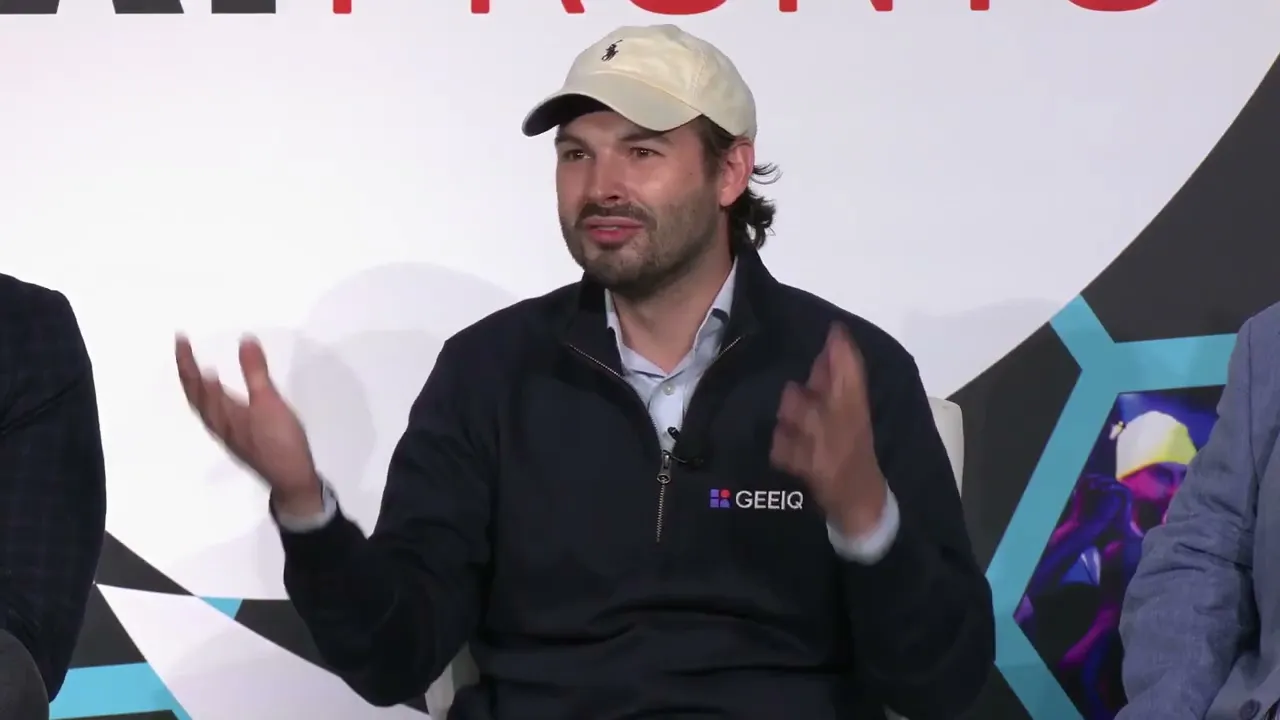
Gaming is the new premium video: GEEIQ CEO Charles Hambro at IAB PlayFronts 2026
Event
IAB PlayFronts 2026
About this session
Charles Hambro joins Roblox, Google and WPP Media at IAB PlayFronts 2026 to make the case for gaming as premium video, and for measurement as the thing that unlocks the budget.
Transcript
This transcript was generated from the session recording and lightly edited for readability.
Good afternoon everyone. Hi, I'm Jeff Birnbaum I lead Google's mobile apps partnerships across both Google ad manager and AdMob I've got to share the obligatory over the last session before networking So want to make sure this is as compelling and interesting as possible. We've got a great panel here to make sure that happens. We're here to continue, not really to start because this has been a long process for everyone and discuss throughout the day, the narrative and what constitutes premium video, but really doing it in the context of immersive content and immersive gaming. So for those environments, we're talking about fully leaned in experiences where people really aren't exhibiting second screen behavior oftentimes and are immersed in the content, and that provides wonderful opportunities to immerse with brands as well.
The stats are oftentimes repeated here, but it's been a theme throughout the years that the share of time obviously spent in gaming relative to the anywhere from five to 7% of media budgets that it captures represents a big mismatch, I would say for the time and the growth that we're seeing in immersive content like Roblox and other platforms, that is even more exaggerated. So today we're going to discuss how brands and agencies can kind of close that gap, focusing on video, evaluating how gaming fits into the broader mix, begin to treat immersive gaming as the full funnel platform opportunity that it really is. So, let's jump in. We're going to start off kind of with that same foundational premise that I mentioned.
And so, kind of I'll start with Mike. What evidence would you provide to a brand that gaming environments are fundamentally different, even better than other traditional advertising environments? Yeah, and I'm Mike. I run our agency partnership team at Roblox, working with brands and agencies to be able to activate media across the platform. I think from the Roblox side, we see about 75,000,000 monthly active users just in The US, and they're spending over two and a half hours a day playing on the platform.
We partnered with Ipsos on running a study to compare Roblox streaming, and social, running the same brands, same creatives, just earlier this year. In our recent white paper, we saw and I have notes here, just so I can make sure I don't get the numbers incorrect 52% of the people paid more attention to ads on Roblox than they did on social and streaming, and that 13% or 13 points higher than streaming, and 11 points higher than social. And then on that same study, on that same white paper, we tested 14 points higher on ad memorability, and purchase intent was 1.25 times higher. So when we think about immersive environments, and why advertisers should be a part of those immersive environments, it really comes down to the fact that users, gamers, they see those ads, they member those ads, and it actually does drive impact.
No, thanks for that. We'd love to also kind of explore that, like, kind of with you, as we think about, like, shifting from impressions that can be somewhat passive to more kind of active, engaged users kind of leveraging more sophisticated technology sometimes in this space. Yes. Hi, everyone. Charles Hambro, CEO, co-founder of GEEIQ, a market intelligence business that supports brands and agencies reaching gaming audiences across the board.
Yes, following on from what you said earlier, Mike, I think it's a point of passive engagement versus active engagement. And as we've seen time grow and things change, social media used to be called social networking, changed to social media, it's now very much about content consumption and there's an interruptive ad in between that content. With gaming obviously these are environments that aren't just about immersing yourself with content, you're there with your friends. It's a very different sort of environment than you would even have on traditional social media. So what that does from a brand perspective, what that does from a player perspective is essentially a more engaged user at the time of seeing the brand.
So, yeah, I mean, that's what I would say, really. Yeah. Very helpful. I think we'll kind of have all the panelists kind of chime on this one. So Frank would love your perspective from, like, the agency media buyer, you know, perspective on this one for you.
When we look at gaming from an engagement, I mean, I just think it's it's here. It's gaming is not just this passive thing that people seem to think that like, hey, it's nice to have. It's a younger audience. That's where they're going. That's where they're spending most of their time.
They're dual screen, to your point with social is, you know, it's not a doom scroll. People are actually looking at their screen. They're getting, you know, more and more. We're going from a time when rewarded video was this kind of a joke on your mobile device, to this really benefit that people understand the difference in that, and that's giving something back to consumers. So you're getting focus, engagement, and understanding of the brand, and brand loyalty.
So I think you're just seeing a different change. It just I we need everyone to stop thinking about gaming as like an afterthought, but it's an 18 to 34 year old, it's anyway, everyone's doing it. Everyone's gaming, so why is it the last piece of the puzzle? Yeah. And, you know, a testament to kind of rewarded, it kind of, has had such an evolution, right, from a joke as you said potentially to a real tried and true gaming format, it continues to provide kind of a lot of revenue in that context, but you're seeing kind of non gaming brands adopt the format as well, so I think that can allow it to become kind of part of a more cohesive buy.
I want to dive a little bit into, and we'll start with you Mike here, just kind of from a Roblox kind of perspective, is the budgets that you're kind of going after, do they sometimes get lumped kind of with traditional video, you know, some of those metrics that you were mentioning, like are you being asked for metrics that align with the Roblox platform like you have there, or trying to be kind of compared and measured with other types of video? Yeah. I think, if you look at the evolution of Roblox from a media standpoint, if we were to have this conversation two years ago, we would be talking about do an integration into a game or build your own game. About eighteen months ago, we were on stage with Google announcing rewarded video for the first time allowing programmatic ads into Roblox.
Since then, we've started to roll out additional DSPs, more ad formats, allowing more transactable media to be able to come into the platform, which opens up the doors for most brands to be able to activate easily and seamlessly. For years, it was difficult to activate, especially within Roblox Immersive's platform. We've made a ton of strides to be able to make it easier, to make it programmatic, to be able to turn our home page into video ads. The whole idea is how do we make it easy for brands. But not only easy, it has to drive outcomes.
And so working on delivering more measurement, more capabilities around safety, suitability and being able to prove those outcomes is a really important part of how our media business has really grown. That's great. And Frank, I guess compared to like how your agency, kind of the media world, like at large, is comparing whether it's CPMs, viewability to whether it's the most traditional kind of forms of media like linear or even CTV these days, like how do you see kind of metrics kind of being evaluated in the gaming space relative to other Well, they're delivering on the core metrics, first and foremost, as, you know, Mike says so nicely. And I was just thinking in my head when there's not too many places you go now that you don't go through a side door.
You get right through your content. When you go to Roblox, it's the home it's a home page. It's an entry point to grab all user attention. When you think about how fractured viewership is, how many subscriptions you have and every, it's really hard to grab users' attention. And whether it's co viewing in the sense of watching your child play, if you're playing or you're a younger audience, I when we look at it, we're like, alright, well, we know we're going to get these metrics, but you get engagement.
You get brand loyalty. You get brand love. That's where rewarded video I didn't mean to call it a joke. I apologize. It started in a very, you know, weird place for me, and it came to this place where it really started building, it allows itself to be that reach play.
And I think that's just the tip of the iceberg. I think that's just where we say, hey, we have a reach play. Gaming naturally should be there from a video perspective. Then you just get deeper in the metrics of what we can do and what can be delivered on, whether it's through technology or through the targeting, and then I think the possibilities are endless. Yeah.
And I do think, you know, brands, you know, not app install kind of advertisers, I really needed a long time to kind of go on that evolution. So, like, the comment, makes sense kind of in the context of like, was not something many brands kind of were considering until they could get it in more premium environments. Well, And yeah, one of the big things that us and Roblox worked with is, it took me about three months to re educate everyone on what rewarded video was, because everyone had the old three twenty by 50 on your mobile device. Everyone was so used to the different formats, and that you'd get a, you know, CPC or CP, or something of that nature, and you get a free sample of something. And to this, you know, you watch the video, you're going to get a free hat.
You're going to get, you know, again, brand love. So like, I think it just evolved so much. It took re educating people as digital constantly changes and gaming becomes more and more immersive. It's it's a rewarding video, like it truly is that. At one point, wanted to change the name, but luckily everyone caught on to it.
Yes. No. They've made discussed name changes over the years, value exchange, Like there are, the users want to see these ads and they are kind of, happen to be getting kind of rewarded for them so that they can spend more time in content that they love, right? I think that kind of sums it up. Switching gears over to you, Charles, like, you you're kind of providing back end analytics, technical intelligence, like, behind kind of a lot of these campaigns.
Let's think about kind of outcomes. You know, I know it was mentioned earlier, but we wanted to kind of also touch on the recent Sam Club campaign as a proof of concept and if you could talk us through that the mechanics on how you work together to drive those results. Yes. I will do my best with that. You'll have to forgive me.
I'm sad to say I'm in the ivory tower with my company, so I'm not really in the midst of it, but we can rely on Mike to really get the details of that. You're sorry, Mike. And away from home for two weeks. Yes, exactly. We will.
Double. No. So that's a very interesting one. And I think it's going back and jumping off on what's been said here, it's something that gaming can really provide or immersive can provide that most other channels can't, is that ability to do value exchange in such a very clear way. I think with Sam's Club, that's a membership program ultimately.
And if they are educating a new generation of people on what actually Sam's Club is and what it does, how does that translate itself in the Roblox ecosystem. So I believe that was integration into three very popular experiences inside Roblox, and the mechanic was giving them a membership, which was giving them discounts on many different things within those experiences. So that way you're really kind of educating the player about what you do as a brand at the same time, but doing it in the environment that they are familiar with and understand. And I think in the results, that translated itself in terms of all the Brand Outlet stuff. But I'm going to let Mike Speaking of give you all speaking of correct results, like the scale of these results is really kind of impressive, and we'd love to have you Yeah, and that one campaign delivered 5,000,000 engaged minutes, over 1,000,000 virtual memberships cards that were claimed, 87,000 virtual items.
But we partnered with Cint to actually measure outcomes beyond just what happened within the games, and that's where we were really kind of excited about those results. 18% lift in sales per cardholder and 6% lift in conversion. So it just goes back to what you can't get through most media properties. That would be impossible to do in any other channel. In any other channel.
In that way, that creative, and actually to get the real world impact, because I think we talk so much in gaming about what happens inside the digital space itself. You can't say IRL at ropes. Did you know this? Roblox says you can't say IRL because for Roblox, it is real life for those players. So you have to say in physical world.
So I'm going to say in the physical world, it's amazing to see that uplift and that results in physical world because there's a big disconnection a lot of the time with regards to we're doing all of this stuff in these gaming platforms, and it's amazing. And by the way, the minutes spent is incredible, but what is actually happening happening in the physical world? And that was a fantastic proof case, I think. So one thing I would say, this is totally a script. We love that.
Okay. Thank you very much. Yeah. I'm not sure. IKEA did this great thing where they were they were hiring people in Roblox, they were training them, and they're all this fun stuff.
My son and all his friends started trying to apply, and they started doing it. We have monthly trips now to IKEA. The real the physical to your point, the physical destination Yeah. Because of that experience that that was given, and they were able to show and deliver what is in the store in Roblox, and they deliver this real life experience that now my son thinks it's fun to go into IKEA for about thirty minutes. We had Swedish meatballs, and then we run he runs around, and he goes into each room, and he likes to pretend which one's his.
But I just think it shows, to your point, the retention of it all, like and the fact that they retain it, and these brands want to move these brands are moving forward as long as they're making an impact in an authentic way. Kind of impossible to do that campaign in any other channel Agree. In that way. And herein lies, I think, bit of the problem. It's because there are the possibilities are endless and there are so many ways to engage its audience.
It's new and quite scary for lots of people. So I'm quite excited because I think we are now graduating beyond innovation, now into marketing, and with the sort of the technology improvements that Roblox is now doing with media, it's enabling marketing teams to do something that's a bit more like for like whilst taking advantage of the immersive aspect. Yeah. We actually have keep iterating and delivering on new media formats within the platform. I mentioned home page units launched over the last year, rewarded video eighteen months ago.
But last week, we announced that we're going to be testing pre roll ads in Q4. So as we continue to be able to open up new ad formats that take standard creatives, that make it easy, that make it programmatic, it makes it easier for brands to come in, test, to learn, to measure, and ultimately, hopefully, scale. Yeah. There's too many things to buy, right, like in terms of customizing creative, like, I kind of my non gaming business kind of covers a lot of publishers trying to implement native and like scaling things that are like not standard, even if the platform like is not standard is always a challenge. So I think the more standardization we could get here, the better.
And it kind of brings me back in thinking about how the industry speaks, I think, to the agency community, like from a publisher side, and Frank, I would love your perspective here. I was at CES and I remember kind of sharing with one of our agency leads who kind of sells on behalf of Google Ad Manager platform. We had like a package of gaming and other app inventory of them to market, and I kind of was asking in the evening how did some of those discussions go, and I was like, well, everyone wants to talk about video or display. Like, well, apps and gaming have both, right? So, but so, like, it sometimes just falls through these cracks.
Like, what do you think It the way to deal with that goes back to like my rewarded video conversation. There's this weird lack of understanding in gaming that these old the ads are all custom. It's you can't it's not video or display. It's gotta be this heavy lift, and that's the first thing we did when we worked with Roblox and WPP, and we worked on a partnership, where we're like, here's standard all stuff. Here's your stuff that you can just do for a reach.
Here's the stuff you can do for acquisition. Obviously, mass awareness, the homepage, and it took a lot of conversations there, because again, I don't know why gaming gets it's this automatic little bucket, and people think that it's going to be this heavy lift. It's part of culture. It's part of everything, the zeitgeist, everything we do, but it's been taking a while, but luckily, like, I'm hoping you're going to see the next level of fandom. As you've seen sports blow up, I think gaming should have its time in the sun, and I'm hoping, you know, with the launch of GTA and people seeing that, the success of Roblox of where it is right now, you know, we continue to see that gaming is not on the outside.
Really, for anyone, as a follow-up, you know, at the end of the season or kind of with the end clients, is it more you think kind of busting down some of those kind of myths on the creative side that there are standard ways to integrate or is it more kind of finding the right media planning budget? Is this in the programmatic budget? Is it in kind of a video budget? Like, where do you think that the efforts need to be directed? Think it comes from a disconnect between planning and investment, because planning then tries to put it just into gaming, and we, in investment as I am and investment at heart, try to push it back into video, there becomes a lot of back and forth.
So again, I think it's a lot of that education and understanding, because they're hoping clients will be they'll be okay with it, and I I think in our day and age, we have to make clients uncomfortable. We have to educate them, and it's like, hey, this is video. Show it to them. Let them experience it. And, you know, I always have my case study with me and my son, and I'll FaceTime him, or like, and I'll show them like, this is what they're doing.
This is what kids like, it's a video. And even when you think about, you know, I came home, and I was explaining to my son that YouTube, he doesn't have go to YouTube anymore by itself. It'll be embedded in Roblox. That was a huge deal for him, because he has not two browsers running, and his iPad won't slow down. So I'm like, it's again, you're answering an experience the it's an immersive experience.
You're answering what your users need, and it can be video, it can be display, it can be whatever you need it to be, but it shouldn't just be put in a gaming bucket. Yeah. That's where it fails. Yeah. I completely agree with that.
I think that the g word the gaming word is a problem. Yeah. And act the reality of the situation is this is just a bucket of audience that gives you more opportunities to reach them in new ways that you haven't done before if you want, but you can do it in the traditional ways in that bucket bucket as well. And I think I also think the buyer potentially doesn't play these games. And that's a challenge.
Would agree with that, and I think buyers rely too much on programmatic Yeah. To just find users at times. I think we need to do a better job, because gaming as a whole needs that kind of push forward In those properties, you know, just to be doing that. And then the video, it's, you know, things can land there, but there's just so much value in jumping on a phone Mike. Jumping the phone with you, just to have a conversation about data, what we can do, how do we work together.
It's not just, oh, well, we deliver programmatic found, million impressions on Robo. Like, it doesn't that's great if you're doing an audience buy, but like there's so much more. And people think they're checking off the box by just letting that happen. Yep. Yep.
Agreed. Yeah. I think there's a lot to be said for the end user kind of not understanding kind of how immersive and engaged, you know, you can be, you know, in that environment. Seen kind of I don't You see those pitches resonate so much more when it's like, oh, I love that game, or I love Duolingo. Yes.
I'm going to buy your app. Even experience Roblox in the same way that an actual user experience. This is embarrassing. I've got my friends, really, on Roblox. And I know that it's such an important part of the core user base, that and is a totally different experience.
They're using it as if it's their social media platform. That's not how I'm using it. I'm testing games. I'm going in. I'm seeing cool stuff, but it's not my destination where I'm catching up with my friends, and that's a big difference.
Is that, like, the perception kind of internally at Roblox, kind of Yeah. I I think that there's the you know, the audience behind Roblox is really interesting, right? There's about a third is 13, a third is, teens, and a third is adults, right? And when you start to break that down, 75,000,000 users monthly in The US alone, a third is a lot, right? And so there's a lot of Gen Z audiences here.
There's a lot of older audiences here, and because we have logged in users, we can define that, right? And I think when we think about you mentioned immersive. Immersive is the platform and the content, but we want to make sure that, as a brand, you don't have to have custom immersive content to go into that immersive platform. You can use standard creatives to reach someone who is an immersive content, right? So the platform itself is the immersive piece, and if you have the time, if you have the energy, you have the budgets to do something like the IKEA example or like Sam's Club did, it's incredible, and it can work like crazy.
You don't have to start there. You can start with standardizing media within the platform to make it easy, to find out, Does this drive my business results? And if it does, great. What does that look like for Round two? Yes.
And we've been on that journey to kind of together moving to more standardized formats that we're working on together because you really need to be able to play kind of in both, right? You want kind of the immersive kind of custom execution for the brands that already love your platform and are willing to kind of commit, you know, upfront work on custom things, but then you need that scalable, you know, reach play out, you know. The one thing one thing I would say about that also, like, I would love to see from the next roadblock study is something on co viewing. Because we nailed it with video, and we nailed it, but like, how often my son's next to me playing it, or my daughter's playing something, and I'm with them in the room, and you're not getting that count in your 75,000,000, but I'm there.
I'm experiencing it. I know steal a brain rot, steal an egg. I I don't play them. I watch them often, but I just think there's more to be said there in the experience, and again, to your point, it's immersive. And I'm sitting there, and I'm having my son explain it to me, explaining me the percentages he needs of Roblox in order for him to get the rarest thing, like the math.
He's beyond himself in math. So like, I just think there's a lot of value in interaction, and a lot that you can embrace from a reach perspective from video, and just what that co viewing looks like. You know, this is all kind of leading to, I think, a hypothesis a lot of folks have in the industry that like, perhaps a lot of gaming buying isn't being properly attributed. So there's attribution issues, right, like here as well that people might be getting results from gaming, like even not kind of knowing that their budget is directed there. Any kind of quick thoughts on how we can look to overcome that with more standardized metrics or kind of anything else on the ROI side?
Yes. I'm happy to so we've made a lot of strides there, and we put a lot of effort over the last few years to bolster the suite of partners that we work with, whether that's brand lift, whether that's foot traffic, whether that's sales, even unlocking new DSPs that have those capabilities, right? So trying to be able to provide any type of attribution that a client's going to be looking for, because every client's going to be very different, and so by us doing that, it opens up the doors for more testing opportunities, and to validate that investment. Yeah, very helpful. I think we have time for probably one more.
I want to think kind of a little forward looking, not necessarily maybe the problems we're trying to solve today, but we know from a lot of what you shared today, like Gen Z, Gen Alpha, are spending an incredible amount of time in both immersive platforms and social media. Social media seems to be capturing a lion's share of a lot of the retail media, CTV budgets. When we look ahead, do we think there's kind of an opportunity to kind of activate retail media, commerce budgets in these environments, or will the focus kind of still kind of remain on identity and trying to drive either brand or app outcomes? I mean, just for me, from step out of gaming in general, I welcome that. I often bring my shopper team in and ask them like, why are we not doing things like this?
The retention from in there, in the experience to real life, whether it's my IKEA example or just seeing what it does in the different ways, whether it's sneakers or some kind of cultural item, clothes, style, so that that's such a representation of the user, that it should if you can have it work other ways, like if you can be like, oh, you know, Roblox works great on this new video card, I guarantee somehow my my kids will find a way to buy it. Like, I just think there's that natural seamless way to flowing, and it really is a place they go to interact, be social. Like, you see them just hanging out just in a big circle talking. I'm sorry. Have no friends.
You enjoy my son. Might be a little weird, but we'll figure it out. But I just think that it's a no brainer, yet it seems like it's so far away. Yeah. I think as time goes up, my hope is it's not seen as innovation, essentially.
I agree. Thank you. It's just totally seen as an audience that is of a certain geo, a certain age, certain gender, and it is just part of the media mix. It's part of the process. It's useless if it's not part of the media mix.
So that's my hope. I think we're getting there. You're plus one. Alright. I think we're right at about time.
We all should be here kind of for a little while in the afternoon. If you'd like to discuss kind of any of these topics further, thank you all for being here. Thank you to our sponsor, Roblox, thank you to AIB, and Mike, Charles, Frank. Really appreciate the conversation, and let's keep trying to change the industry. Thanks so much.
Thank you so much. Thank you, everyone.