Virtual worlds are entering a new phase.
In 2025, brand activity across platforms like Roblox and Fortnite moved decisively away from one-off experimentation and toward repeatable, integration-led strategies that scale.
Based on GEEIQ’s platform-level tracking and a first-of-its-kind survey of 50+ leading developer studios and creators, The State of Brands in Virtual Worlds 2026 captures the structural shifts shaping how brands will operate in 2026 and beyond.
Below are the defining changes.
Platform consolidation is accelerating
Brand investment is concentrating.
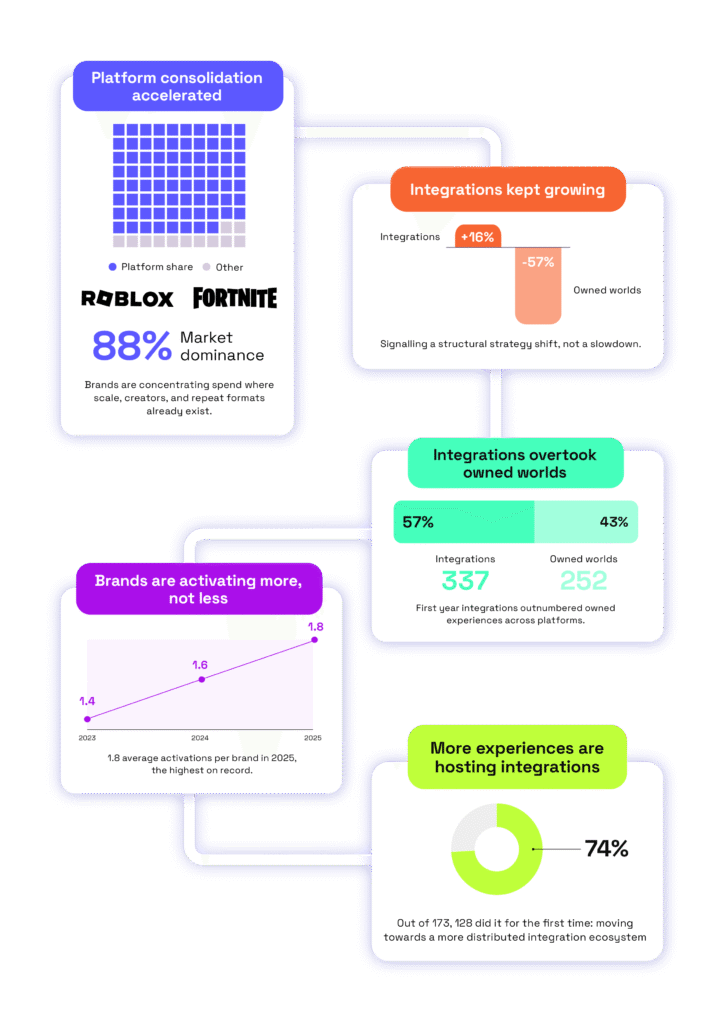
In 2025, Roblox and Fortnite accounted for 88% of tracked brand activations, reinforcing a clear trend: brands are prioritising ecosystems with proven audiences, mature creator economies, and repeatable formats.
Rather than spreading budgets across emerging platforms, experienced brands are focusing on where scale and infrastructure already exist.
Consolidation is not contraction. It’s maturation.
Integrations have overtaken brand-owned worlds
The most significant strategic shift is format-driven.
For the first time, brand integrations outnumbered brand-owned worlds, marking a move toward faster, lower-risk, and more repeatable activation models.
Integration-led strategies offer:
- Quicker deployment
- Access to established audiences
- Reduced production risk
- Clearer performance iteration
Owned worlds still have a role, but they are no longer the default.
Brands are activating more, not less
While overall activations declined year-on-year, the brands that remain active are increasing their commitment.
In 2025, brands averaged 1.8 activations per brand, the highest level on record. This reflects a shift toward sustained programmes led by experienced participants rather than broad first-time experimentation.
The conversation has moved from “should we test this?” to “how do we scale this?”
The integration ecosystem is expanding
The supply side of the market is evolving too.
Of the 173 experiences hosting integrations in 2025, 74% did so for the first time, signalling that more studios and creators are building integration-ready infrastructure.
This suggests a more distributed future, where brands can plug into a broader range of worlds beyond the same headline experiences.
What this means for brand strategy in 2026
The defining shift is operational.
Virtual worlds are becoming infrastructure for brand engagement rather than experimental playgrounds. Strategy is consolidating around fewer platforms, integration-led formats, and repeatable activation cycles.
For brands planning in 2026, the question is no longer whether to participate. It is how to structure participation for sustained performance.
Download the full report
These insights are drawn from The State of Brands in Virtual Worlds 2026, the most comprehensive dataset on brand activity across gaming and virtual platforms.